
Reflection on … the accelerator
Accelerator: "Mechanical device allowing the driver to accelerate the speed of the vehicle."
In paragliding, an accelerator has exactly the same function: to increase the airspeed of the aircraft. This accessory, which may frighten the novice pilot as to its use, can also prove to be a formidable ally in many cases. Like any tool, it is necessary to know it well, to learn how to use it wisely and not to fear it unnecessarily.
We will try to decipher its operation, the consequences on the behaviour of the wing, and finally when and how to use it.
I.- Some notions of aerodynamics …:
To fully understand the operation of the accelerator and the consequences of its use, it is important to have assimilated certain aerodynamic concepts, in particular those relating to the speed polar, the attitude and the angle of incidence.
I.1- Speed polar:
The speed polar is a graph that describes the vertical airspeed as a function of the horizontal airspeed of an aircraft in straight and level flight (paragliding, hang gliding, glider, …). This curve illustrates the different flight regimes of a free-flying wing, and determines all of its performance within each regime: speed, sink rate, glide ratio. Even if its shape remains generally the same, we will notice certain particularities depending on the type of wing (leisure, performance, mini, …) and the flight characteristics expected in the design.
This curve is considered as the graphical representation of the wing's performance. A good understanding of it will allow you to better understand the effects related to the use of the accelerator as we will describe them later. We will focus on this, without going into too much detail.
The different flight regimes are each defined by an area on the graph:
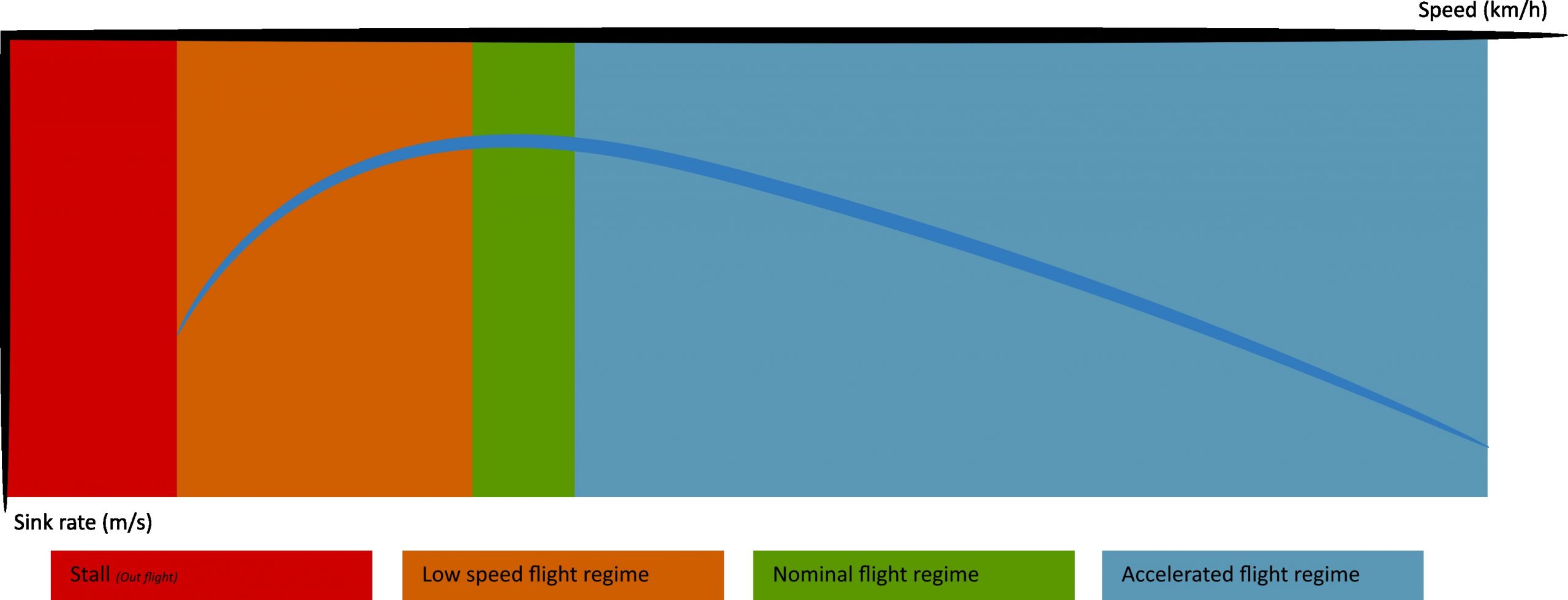
The remarkable elements to remember are:
– Speeds above the minimum sink rate speed, called "1st regime" (descending part of the curve).
– Speeds below the minimum sink rate speed, called "2nd regime" (ascending part of the curve).
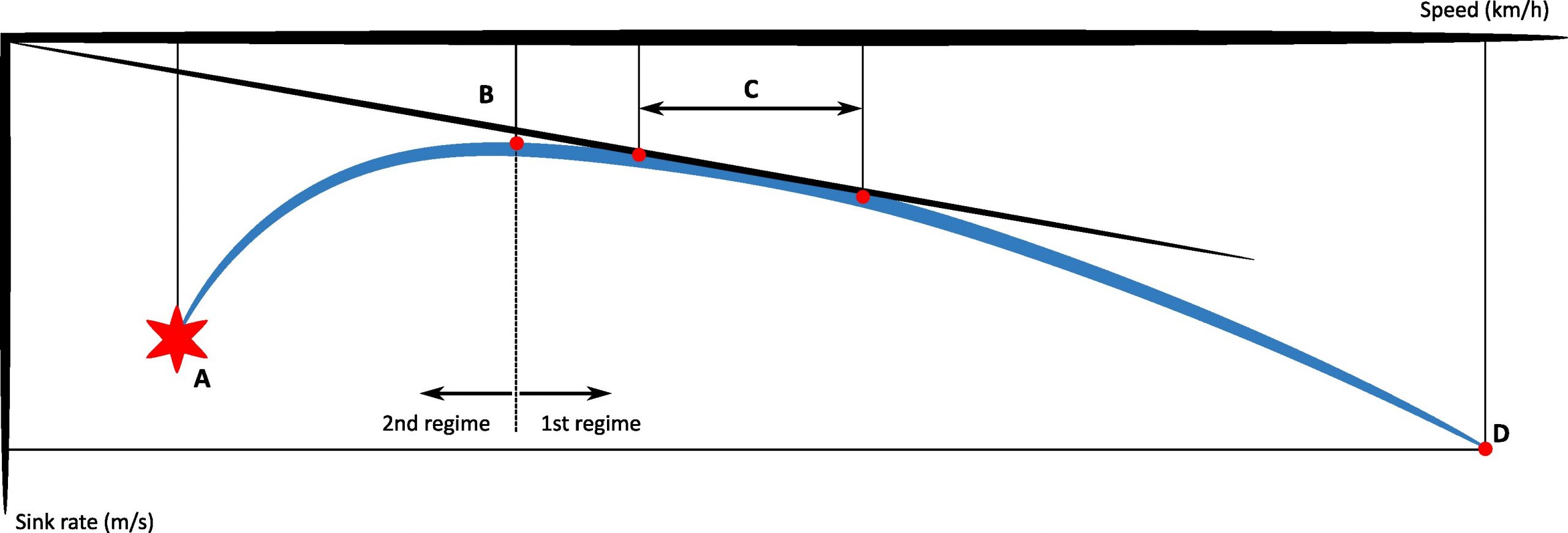
– Stall speed (Point A):
Located at the left end of the curve, the stall point corresponds to the minimum speed allowing to stay in the flight domain. Below this speed, the wing stalls and no longer flies!
– The speed corresponding to the minimum sink rate (Point B):
This is the highest point of the curve, located at the intersection of the curve with its horizontal tangent. We are on the flight regime allowing to descend (vertically) as slowly as possible.
– Max glide ratio speed range (Zone C):
Located at the junction of the line passing through "0" and tangent to the curve, this zone corresponds to the best possible glide ratio for the designated wing. We will see later that this max glide ratio zone can be more or less important depending on the wings, the polar curve can be assimilated to a straight line on a certain portion.
– Max speed (Point D):
Point located at the extreme right of the curve, it corresponds to the maximum speed that can be reached by the glider, after having used all possible acceleration systems. There is no exit from the flight envelope just after this point, but we are approaching the acceptable limit regarding safety.
This polar curve therefore teaches us that there is a direct link between speed, glide ratio and sink rate (in other words: performance). The use of the accelerator must therefore be done with a clear understanding of the interaction between these 3 parameters.
I.2- Attitude and incidence:
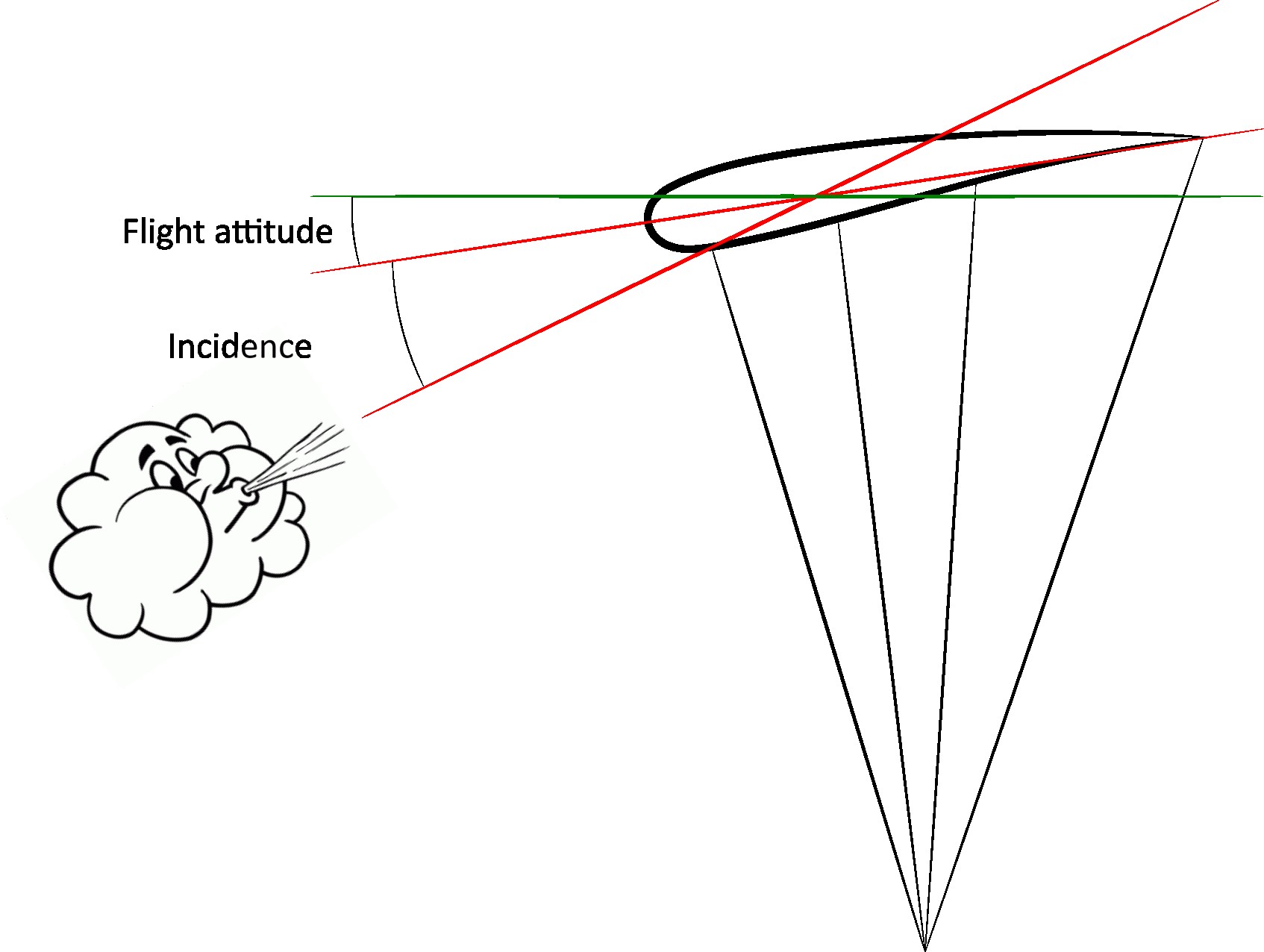
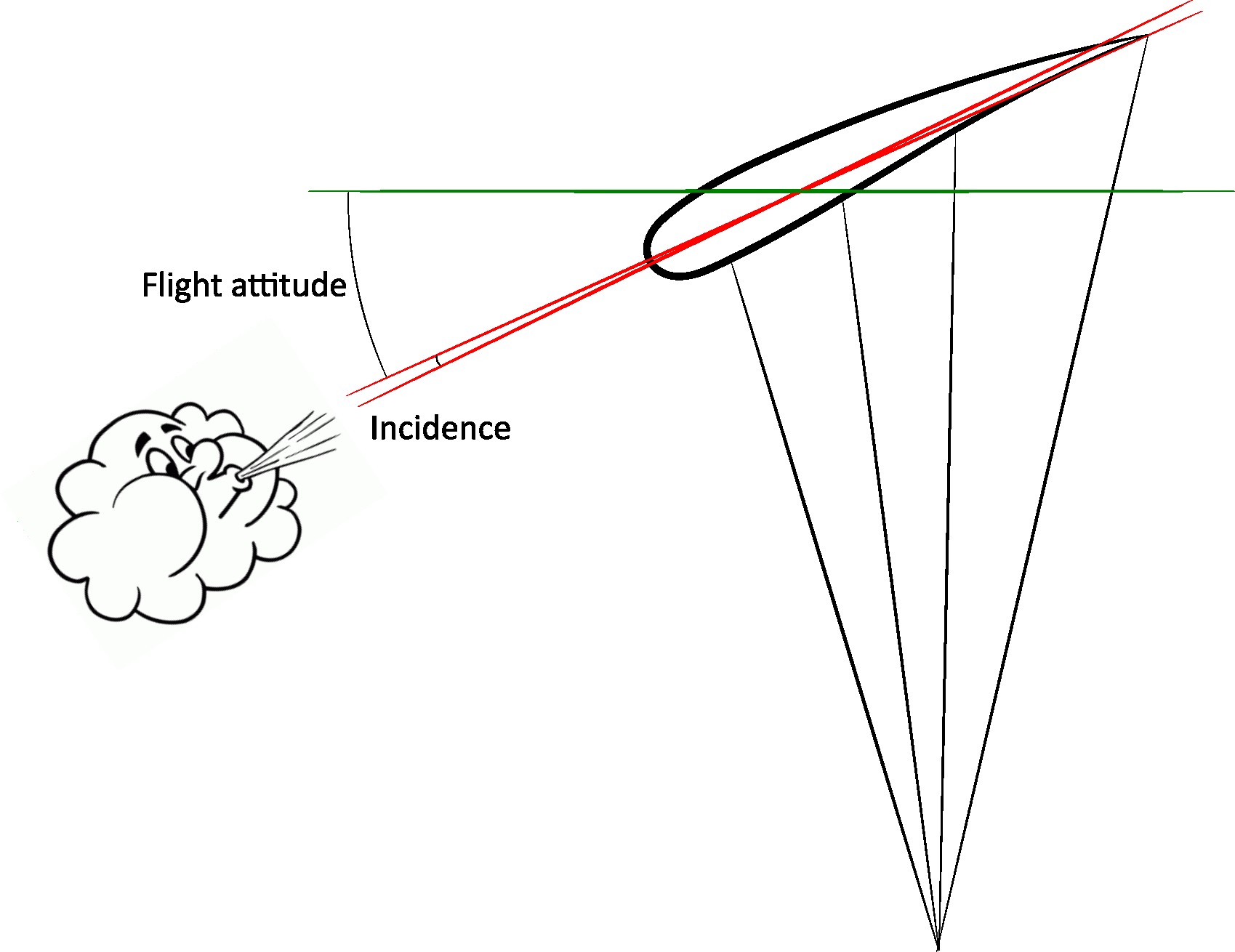
To allow aerodynamic forces to come into play and make flight possible, it is necessary for the air streams from the relative wind to attack the glider at a given angle: the angle of incidence. It is formed by the plane of the glider and the direction of the relative wind (also corresponding closely to the air trajectory of the paraglider). This angle is directly related to the attitude of the paraglider, which corresponds to the angle that the plane of the wing makes with the horizontal.
 |
 |
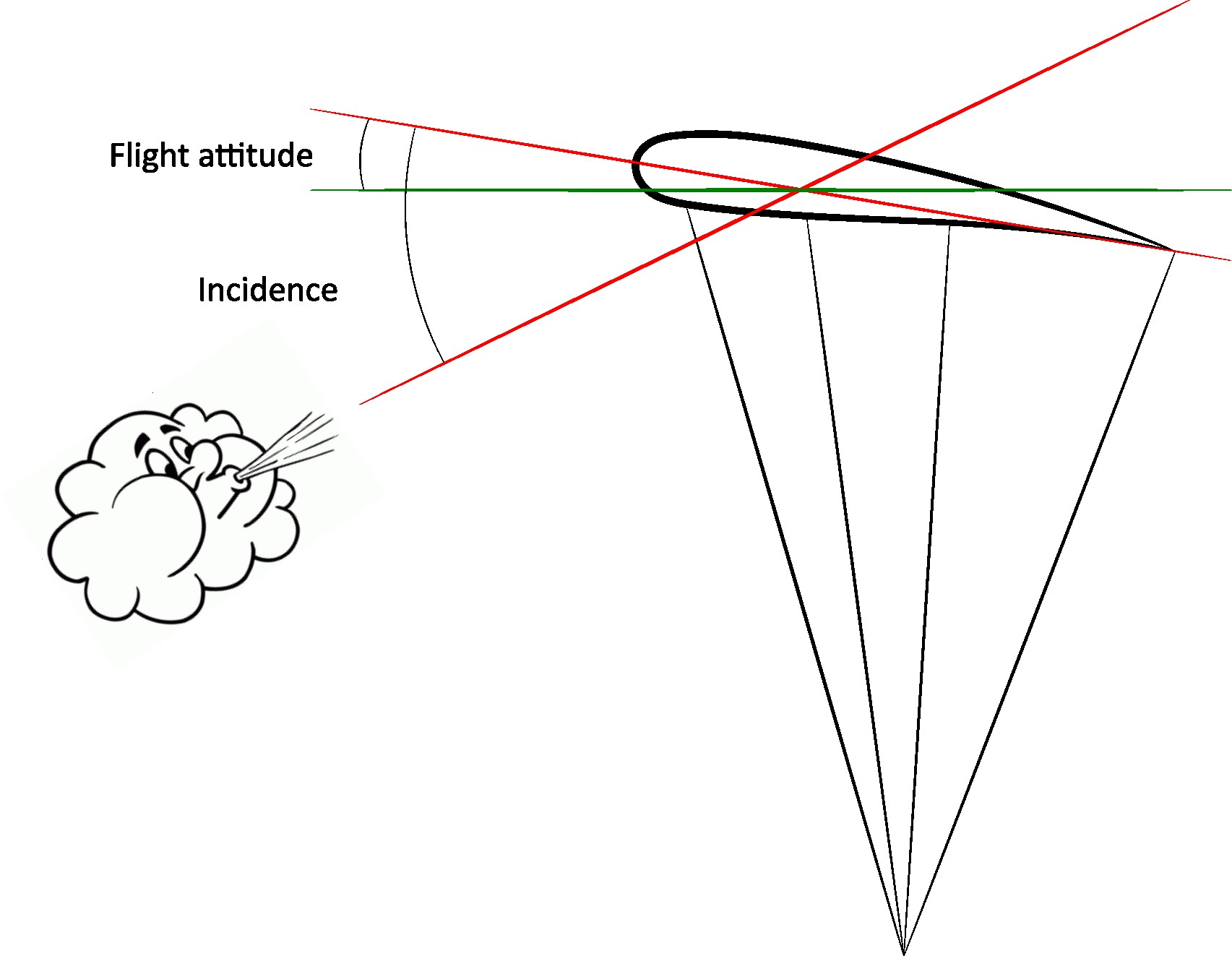 |
In the design, and according to the destination of each model (competition, acro, school, cross-country, ...), the designers calculate a setting (and therefore an attitude angle) which will define the nominal flight characteristics of the glider, that is to say without pilot action. There is no standard for this setting: it is specific to each glider model. We can find this "neutral" point on the polar curve, and determine the nominal parameters: cruising speed, sink rate and glide ratio. In general, on modern gliders, this point is located at the beginning of the maximum glide ratio zone (Zone C), whether on leisure or performance wings. On mini wings of the mountain or speed-riding/flying type, this point may possibly be located a little further on the curve (between C and D), it will then be necessary to apply a good dose of brake to find the maximum glide ratio.
II.- Accelerate ...
Now that we have reviewed (succinctly) the aerodynamic principles in relation to the speed of a paraglider, we will take a closer look at the "acceleration" aspect.
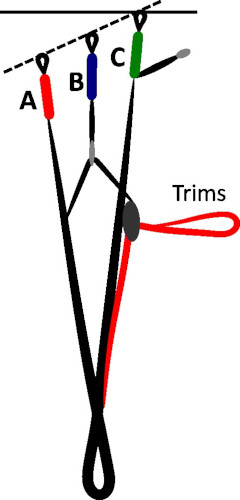
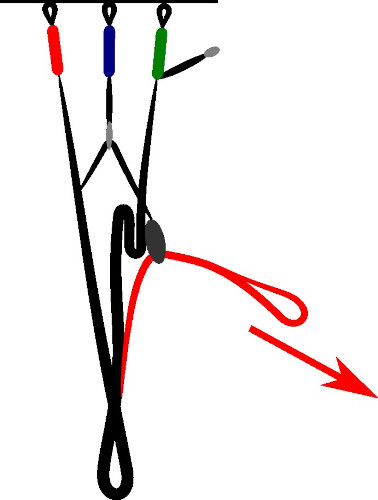
If we want to increase the speed of a wing, we will therefore have to increase its attitude angle to make it more diving. To do this, there are now 2 systems: the foot accelerator, and the trims (also called displays). Both use the same principle: deforming the risers to vary their relative lengths in order to modify the nominal setting.
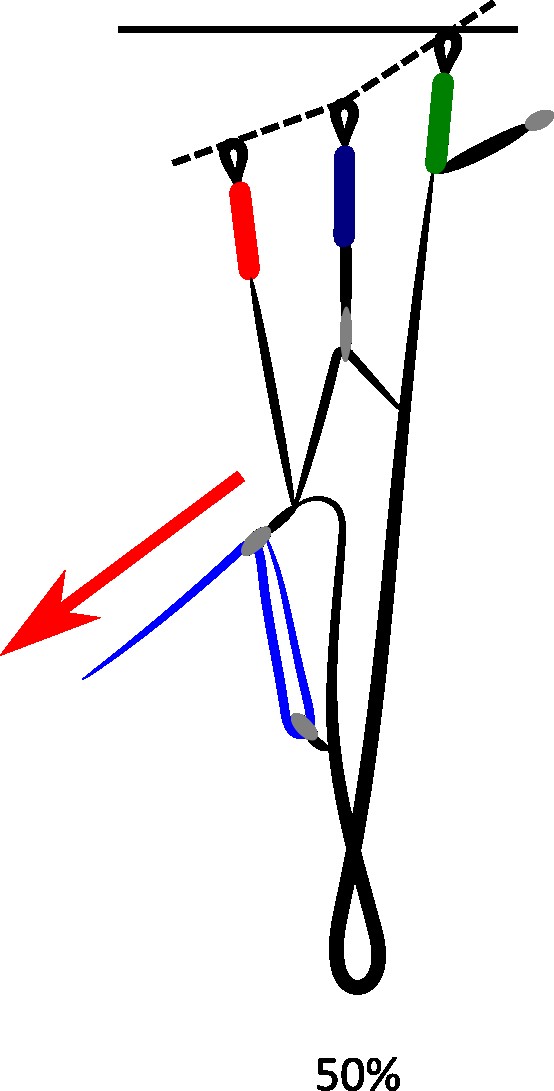
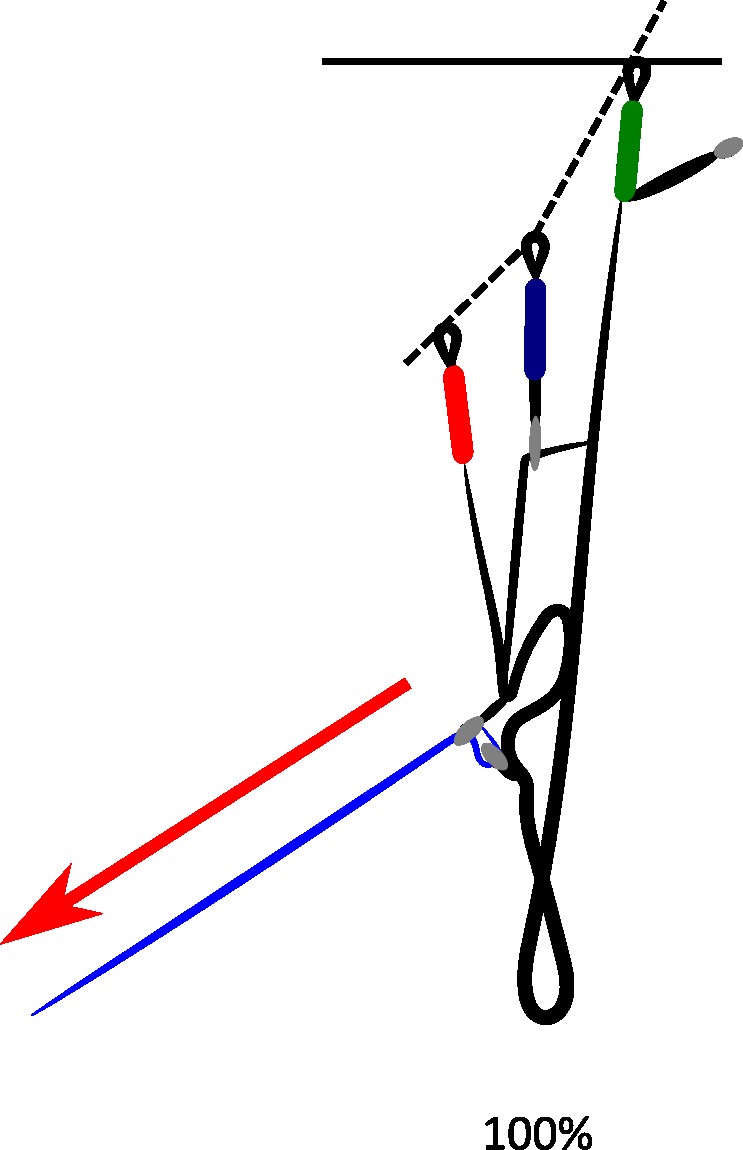
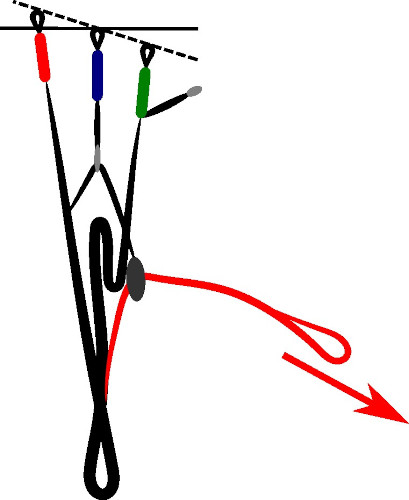
The foot accelerator is the most common device fitted to current paragliders. Consisting of one or more bars, it is connected to the risers by a system of cords sliding in pulleys located on the sides of the harness. The principle remains the same regardless of the harness, but it is up to you to find out about the potential specificities of yours and the correct assembly of your accelerator. Do not hesitate to contact a professional if in doubt.
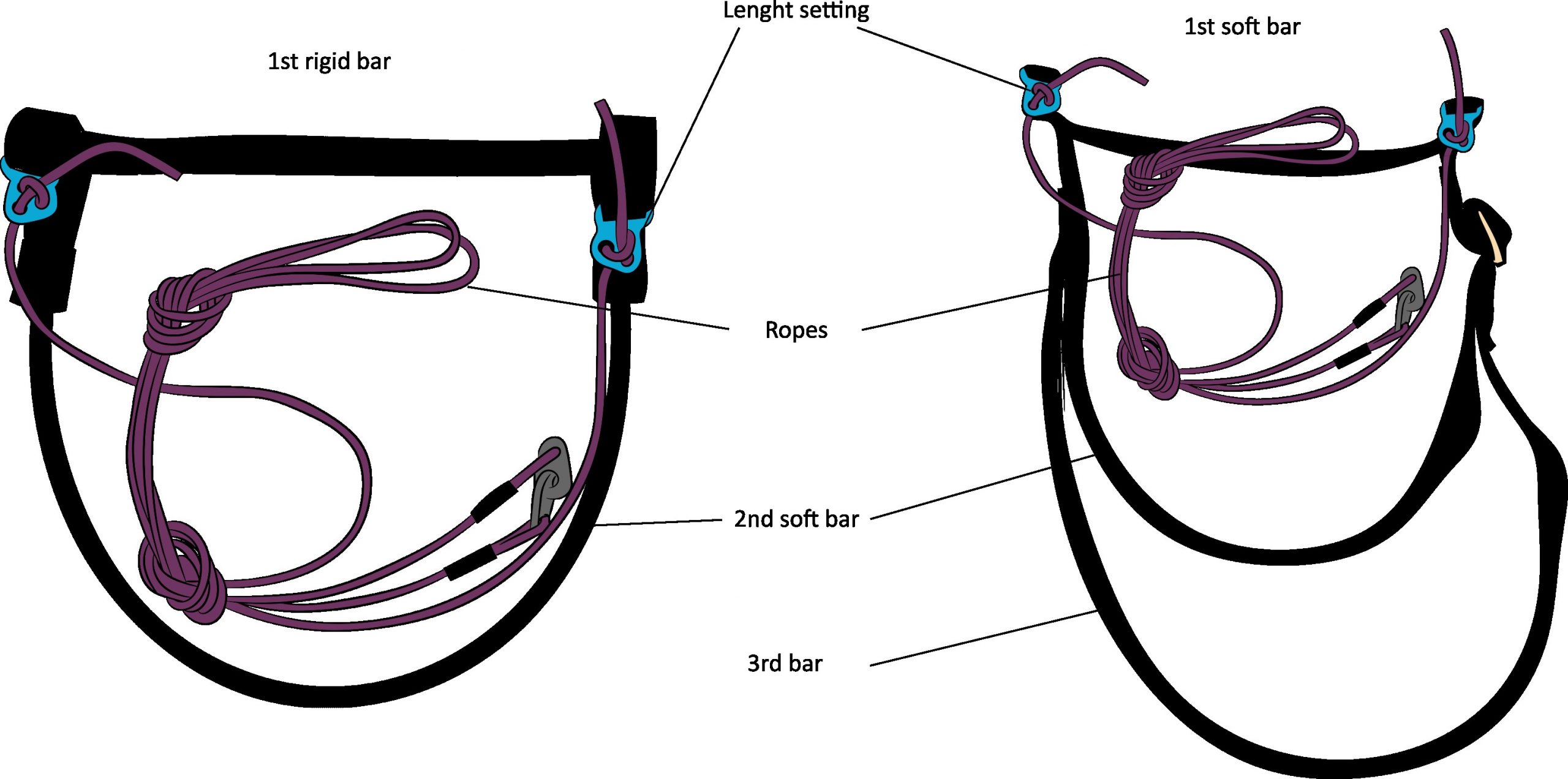
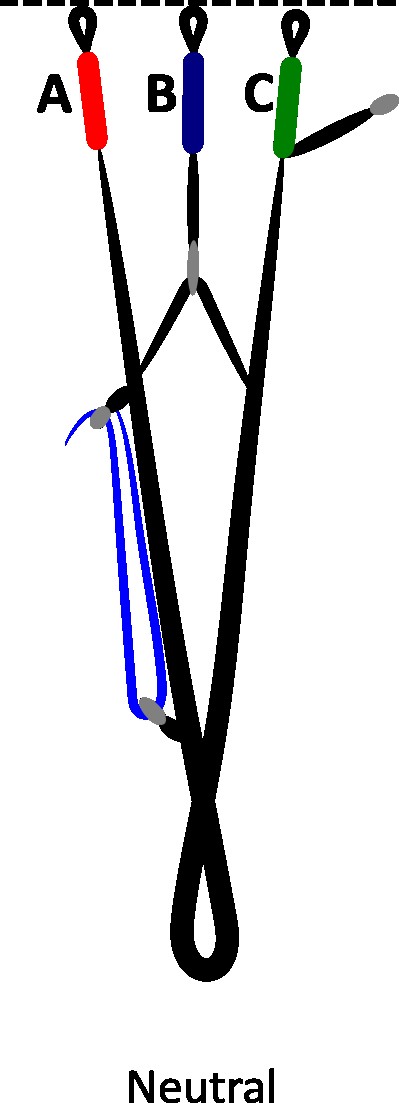
By pushing on the bars with the feet, the pilot acts on the cords which activate the system installed on the risers. This system will then accentuate the angle of attack and generate an increase in the airspeed of the wing. The A / B / C risers are shortened linearly or not. Some systems even allowed the rears to be released when the fronts are lowered. But this system was quickly abandoned because in the event of a frontal collapse the phenomenon was amplified! The 2-pulley pulley system (in blue on the diagram) reduces the effort required on the foot.
 |
 |
 |
In tandem, for example, this makes it possible to adapt the flight regime according to the weight of the passenger. Or to make a wing more responsive on take-off if there is wind.
WARNING!
Trims can therefore offer a relatively precise adjustment, but since they have to be operated manually, they can present a major disadvantage in the event of a collapse because the wing will have to be managed with the brakes: the hands will therefore already be very busy!!! It will therefore be necessary to manage a wing in a more stalled or more pitched configuration, and therefore potentially less easy to return to stable flight. With a more pitched setting, the wing will be much more lively and the collapses more violent.
III.- Action – Reaction!
It is therefore sufficient to operate the accelerator or the trims to modify the setting and the attitude, and to allow the wing to pick up speed. Between the angles of attitude and incidence, the interactions are numerous and complex. In our case concerning acceleration and increasing speed, we will simplify and consider that the more pitched the attitude, the lower the angle of incidence.
When you accelerate, you move a point to the right along the polar curve. Accelerating will therefore have the following direct physical consequences (see polar velocity curve):
1.- Increase airspeed
2.- Change airspeed
3.- Increase the sink rate
4.- Reduce the angle of incidence
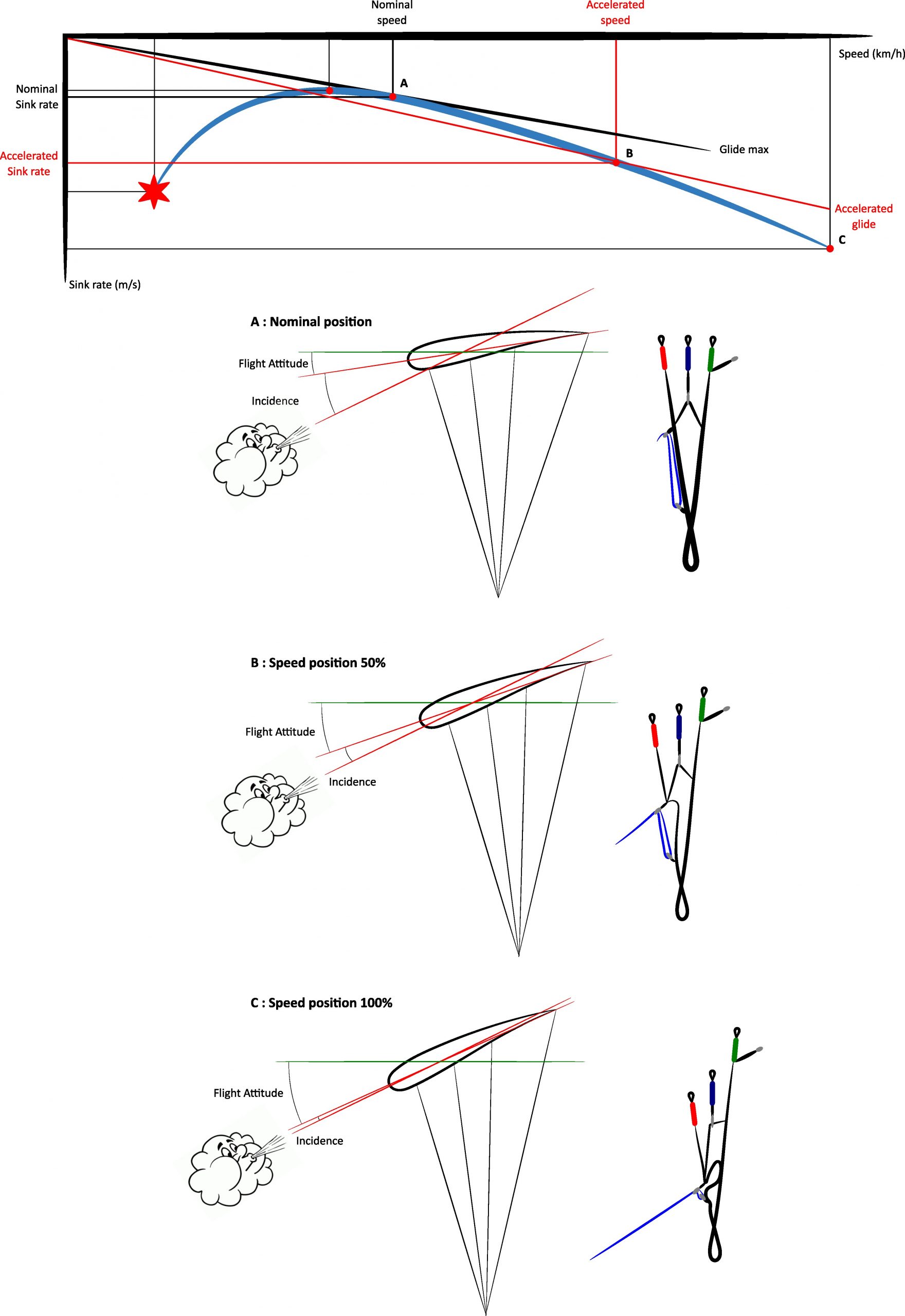
More generally, taking a wing to a faster flight regime will accentuate all these effects, including reactions in the event of collapses. The certifications subject our paragliders to all sorts of flight incidents at cruising speed (nominal setting), but also at different accelerated speeds (modified setting). The effects of these flight incidents are all the more violent the higher the speed. Managing these accelerated incidents will therefore be more complicated than at cruising speed. It is interesting to look carefully at the certification reports to determine the scenarios that ultimately classified the wing in one category or another (A / B / C / D). A single case may be sufficient, such as a large asymmetric collapse with the accelerator pushed to its maximum. This is not necessarily a common occurrence, but you need to be aware of it.
As soon as the angle of incidence is reduced, we see that the air streams will attack the profile more and more in the axis of the wing (decrease in incidence), and that the risk that they pass over (negative incidence) and cause a collapse increases. The wings are adjusted so that this does not happen in calm air, but more "tonic" aerological conditions are quite favourable to this kind of inconvenience. This is one of the only risks in using the accelerator.
IV.- The accelerator: a tool at the service of piloting:
The main tool on a paraglider for controlling the different movements is the brakes. They allow you to manage the 3 axes (roll-yaw / pitch). They are also used to manage the speed of evolution, but to a very small extent and mainly to slow down the pace. When we want to pick up speed, we have very little room for manoeuvre by only using the brake handles.
But there are many situations where it may be interesting to be able to pick up speed depending on the aerology, for example in the case of a poor analysis of the conditions of the moment ...
The 4 consequences of using the accelerator (Paragraph III) can then become valuable allies, together or independently.
There are 2 ways to use the accelerator:
- As a safety tool
- As a performance tool.
IV.1- The accelerator as a safety tool:
Firstly, the accelerator should be considered as an additional safety element to your paragliding equipment. Theoretically, you shouldn't find yourself in aerologically problematic situations, but who knows? It could be useful if you need to accelerate and take advantage of some of the induced consequences (see above). It is not necessary to carry out this experimentation in a secure environment (SIV type) since the wing is not supposed to leave the flight domain, but to start serenely it is essential to carry out your first experiments in calm conditions, with sufficient height and far from any relief or obstacle.
As we saw with the polar of speeds, accelerating can help to degrade the overall performance of the wing, especially towards its maximum. "Running away" therefore remains one of the main reasons for using the accelerator as a safety tool. To move away more quickly from an "unpleasant" area, avoid being sucked into the cloud, or simply fight against the wind (or breeze) and reach the planned landing. The accelerator can also be combined with certain descent techniques such as big ears to make them even more effective. It is imperative that you get closer to professionals to learn more about these descent techniques and their implementation.
IV.2- The accelerator as a performance tool:
Less interesting on "leisure" wings because they generally have their best performance with arms up (especially glide ratio), the accelerator becomes essential on competition wings to optimise the different flight regimes according to the conditions encountered. Performance wings having a more "flat" polar allow them to use the accelerator while maintaining their best glide ratio over a more or less large range.
In competition or cross-country, or more generally in performance flight, you must constantly juggle with the fixed objective, the timing, and the aerological conditions encountered. It is sometimes better to lose glide ratio to arrive more quickly in a generous lift, or sometimes optimise your sink rate as much as possible to gain height in thermals before transitioning to the next relief. The cases are multiple and varied and could be the subject of an entire course, but that is not the point here. For those who would like to deepen the subject, I advise you the excellent video by Baptiste LAMBERT on the Mc Cready. To simplify, you can remember that facing the wind, the accelerator improves your glide ratio and speed relative to the ground. In accelerated transition, high-performance pilots even learn to control the pitching movements of their wing by playing with the accelerator, pushing or releasing at opportune moments. When this is not possible, they use the rear risers because this generates less drag than the use of brakes, and allows them to maintain maximum performance. We will see later that the use of brakes is to be proscribed when the accelerator is activated.
V.- Precautions:
As we have seen previously, the use of the accelerator is not so complicated, but its use necessarily influences the flight. It is therefore essential to respect the following instructions in order to be able to use it serenely:
– The accelerator must be correctly adjusted to allow for safe and optimal use. As a priority, it is necessary to check that the adjustment length is not too short and will not activate the system without voluntary action by the pilot. The risk is finding yourself in flight with a wing permanently accelerated. To be able to use it over the entire range of travel, the 2 pulleys located on the risers must be in contact when the legs are extended. If this is not the case and there is still travel at the pulleys, it doesn't matter, you can simply adjust it on the next flight. In general, the adjustment is not easily accessible in the air and you will need to spend some time on the gantry to rough out the adjustment and refine it after a few flights to measure the adjustments to be made in real conditions (lengthen / shorten / symmetrise). It is important to use the risers of the wing concerned to make the adjustment, and not the pulley system possibly present on the gantry straps because it is potentially different (dimensions). In "performance" use, this adjustment is particularly important since it will allow you to adjust each flight regime according to the bar used, in relation to the polar of the wing concerned.
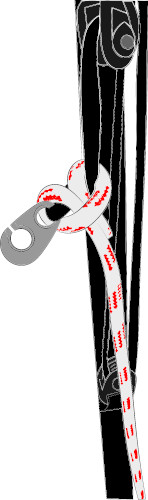
– During the pre-flight check, it is important that no lines (especially the un-sheathed ones) are hooked at the level of the system, especially if the connection is made with split hooks. It is possible that thin lines may get stuck in them. The take-off must then be interrupted. We recommend a lark's head connection of the accelerator line around the split hook located on the risers. In this case, there is no tension at the hook and it will be less convenient for a line to get stuck. The lark's head connection is just as quick and safe to implement.
– In the event of a collapse, it is important to immediately release the accelerator in order not to amplify the induced effects. The same collapse (type and amplitude) will be more violent and complicated to manage when the accelerator is maintained. In addition, the reduction of the angle of incidence during acceleration makes the wing more fragile and sensitive to collapse. You must therefore be particularly vigilant near the ground and the terrain. If trims are used, it will be very difficult or even impossible to neutralise them quickly in the event of a collapse, and you will then have to manage the situation more carefully.
– When using the accelerator, it is imperative not to touch the brakes again, at the risk of triggering a collapse! This may seem paradoxical, but it is true. Without going into too much detail, the action of the brakes will generate a depression towards the trailing edge, which will then cause the centre of thrust to move back. To realign this new centre of thrust and the pilot's centre of gravity (pendulum system), the glider will have to move forward and dive: risk of accelerated frontal collapse!!! This is why adjusting the length of the brakes is essential. If the adjustment is too short, the trailing edge may be deformed when the accelerator is used, leading to an accelerated frontal collapse even without the pilot voluntarily acting on the brakes.
And if you feel the need to brake, why did you accelerate? Well, to hold the glider, of course, if the conditions are a bit turbulent. How do you do it if you're not allowed to touch the brakes anymore? It is possible to hold the glider using the rear risers, often equipped with small handles (at least on recent gliders). By acting on them, you can hold the glider without risking a collapse. To steer the wing in the accelerated phase (without using the brakes), it is recommended to add weight shifting to the use of the rear risers. For the more experienced, it is also possible to prevent collapses by dosing the accelerator to control the pitch.
Conclusion:
The accelerator should not be seen as something frightening and complicated. It is a relatively simple tool to use, which deserves a little time to understand and be able to use it serenely when needed. Take the time to install it and adjust it correctly: its effectiveness will depend on it when needed (a bit like the rescue parachute...).
Now you've read enough!
Go fly and don't hesitate to test your accelerator to make it your best ally!