
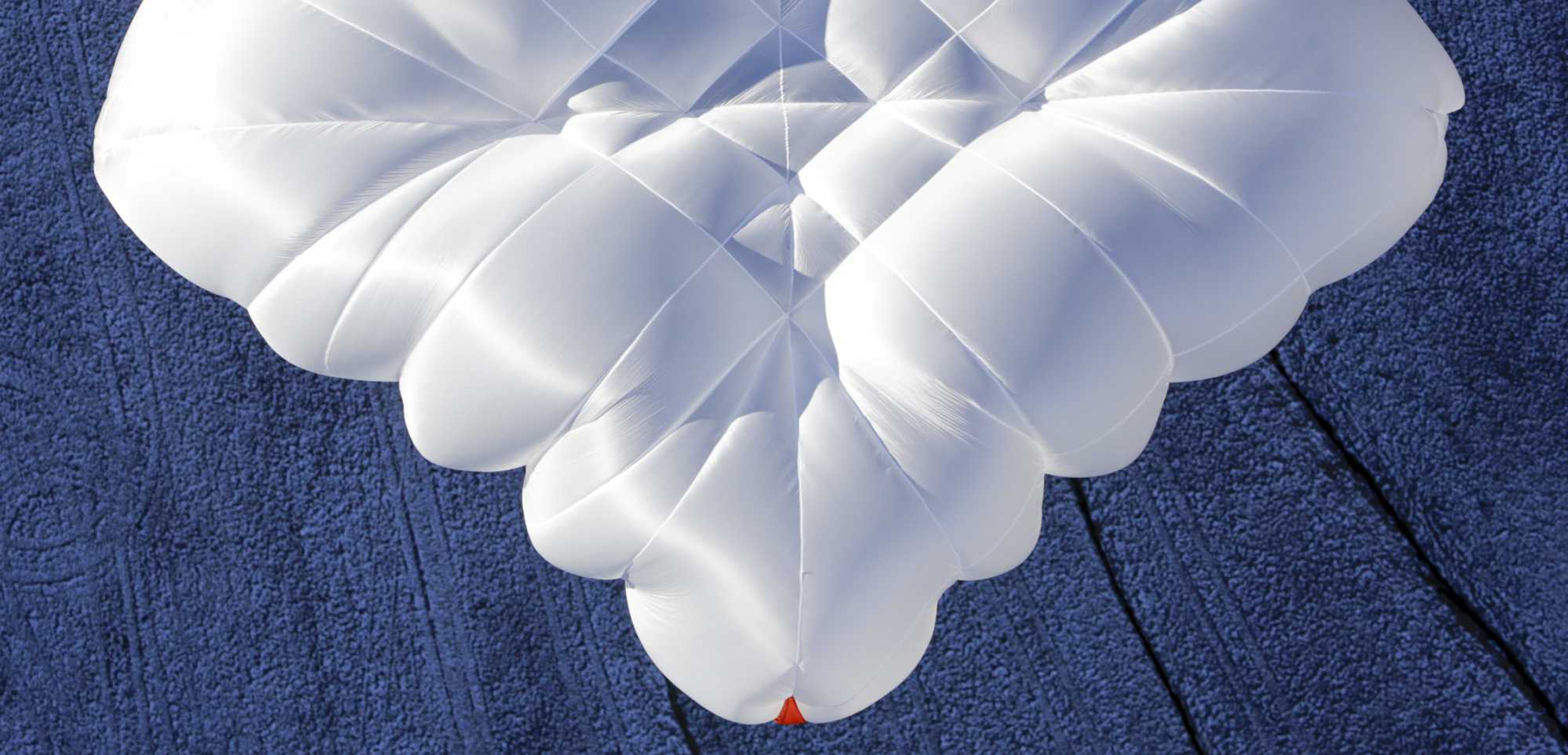
Reflections on rescue parachutes …
Introduction
Paragliding is a "risky" activity.
There are a number of risks that can lead each pilot to a multitude of critical situations:
– Lack of training
– Insufficient experience
– Poor weather analysis
– Collision with other aircraft
– Material failure
– …
All these risks can generally be controlled by adequate training, equipment in good condition (revision), constant vigilance, etc.
But in some critical cases, where it is difficult or even impossible to bring your wing back into the flight domain, there is a solution: the rescue parachute, which can allow you a relatively more comfortable return to the ground …
The rescue parachute has become an essential element of the modern paraglider's equipment. However, it is still too little known by pilots as to its intrinsic characteristics.
It is not enough to carry a rescue parachute to be safer, because its proper use requires certain training, and total involvement on the part of the pilot in case of need.
We will not deal here with its installation or implementation. We advise you to contact professionals (monitors, SIV instructors) to gather their experience and train properly with them. You will find a wealth of practical information in the FFVL reference document on the rescue parachute (author Pierre-Paul MENEGOZ), which you can download here .
A rescue parachute must be chosen carefully, to best suit each pilot and their practice. It is possible that you will never have to use it, but if that day comes it is imperative that you can do so without asking yourself the slightest question about its effectiveness.
We recommend that you carry out your own analysis by methodically comparing the different models thanks to these few elements of reflection.
There are now many models and shapes on the market: hemispherical, square, Rogallo, octagon, pentagon, …
Each manufacturer offers its own design, with its share of advantages highlighted by adapted marketing. All are certified and have successfully passed the homologation tests (EN and/or LTF). These tests verify different aspects of the parachute (Source: EN 12491):
– Descent rate (must be less than 5.5m/s for a non-steerable model, and 4.4m/s for a steerable one)
– Stability (Visual evaluation)
– Opening time (<4s)
– Resistance (Shock test at 40m/s, the parachute must withstand 2 successive tests without deterioration)
The most important parameters (in our opinion) when choosing your parachute are:
– Descent rate
– Stability
– Steerability
The descent rate and stability of a model can be directly linked depending on certain parameters.
Other parameters can then be taken into consideration, depending on the use you may have:
– Weight
– Volume
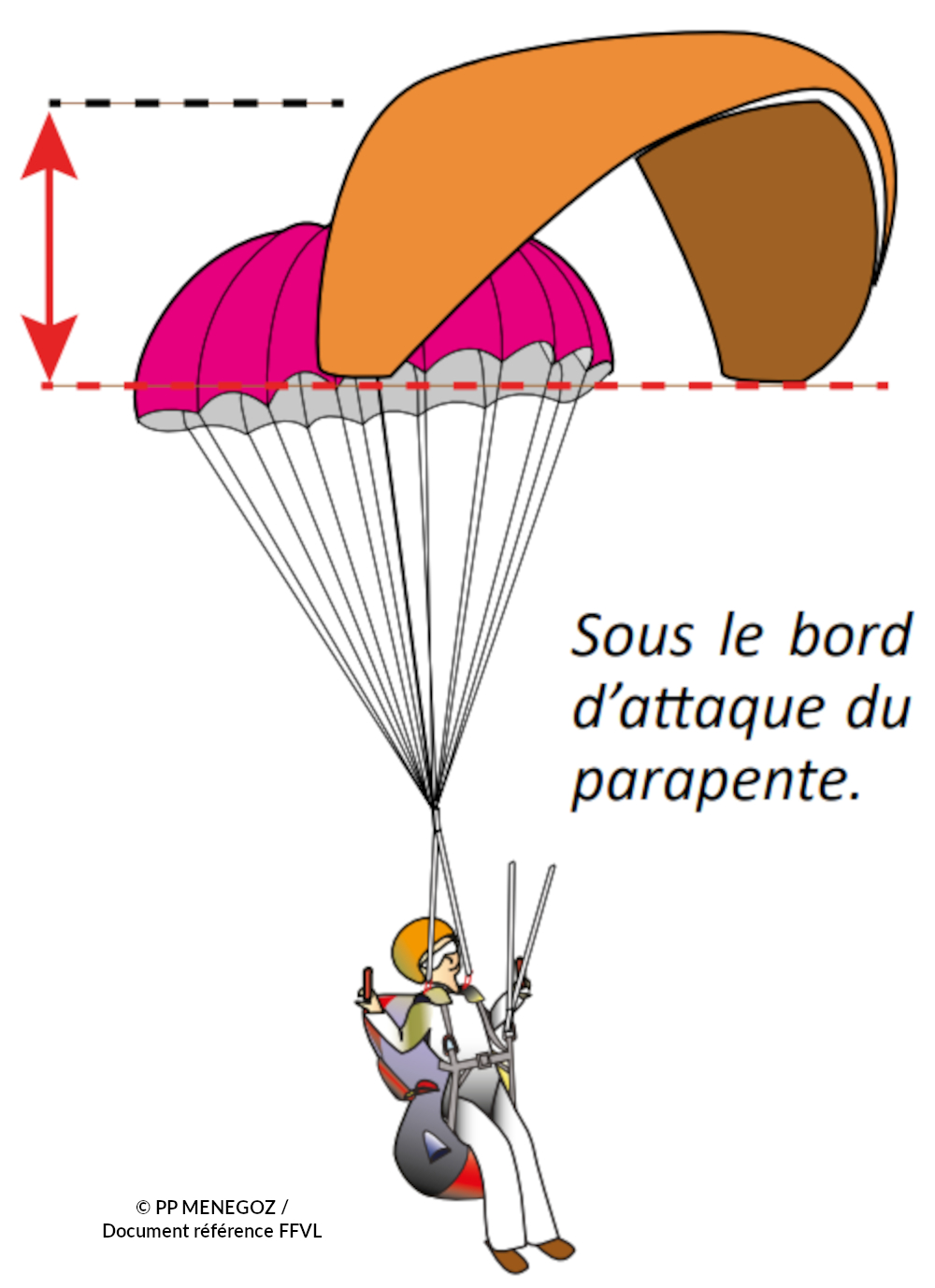
NOTE: There is also a mandatory prerequisite to ensure the proper functioning of the parachute, and this for any model: once deployed, it must not be at the same level (or above) as the main canopy. It could be hit by the canopy at the time of opening, or be in its depression and not inflate properly.
The sink rate
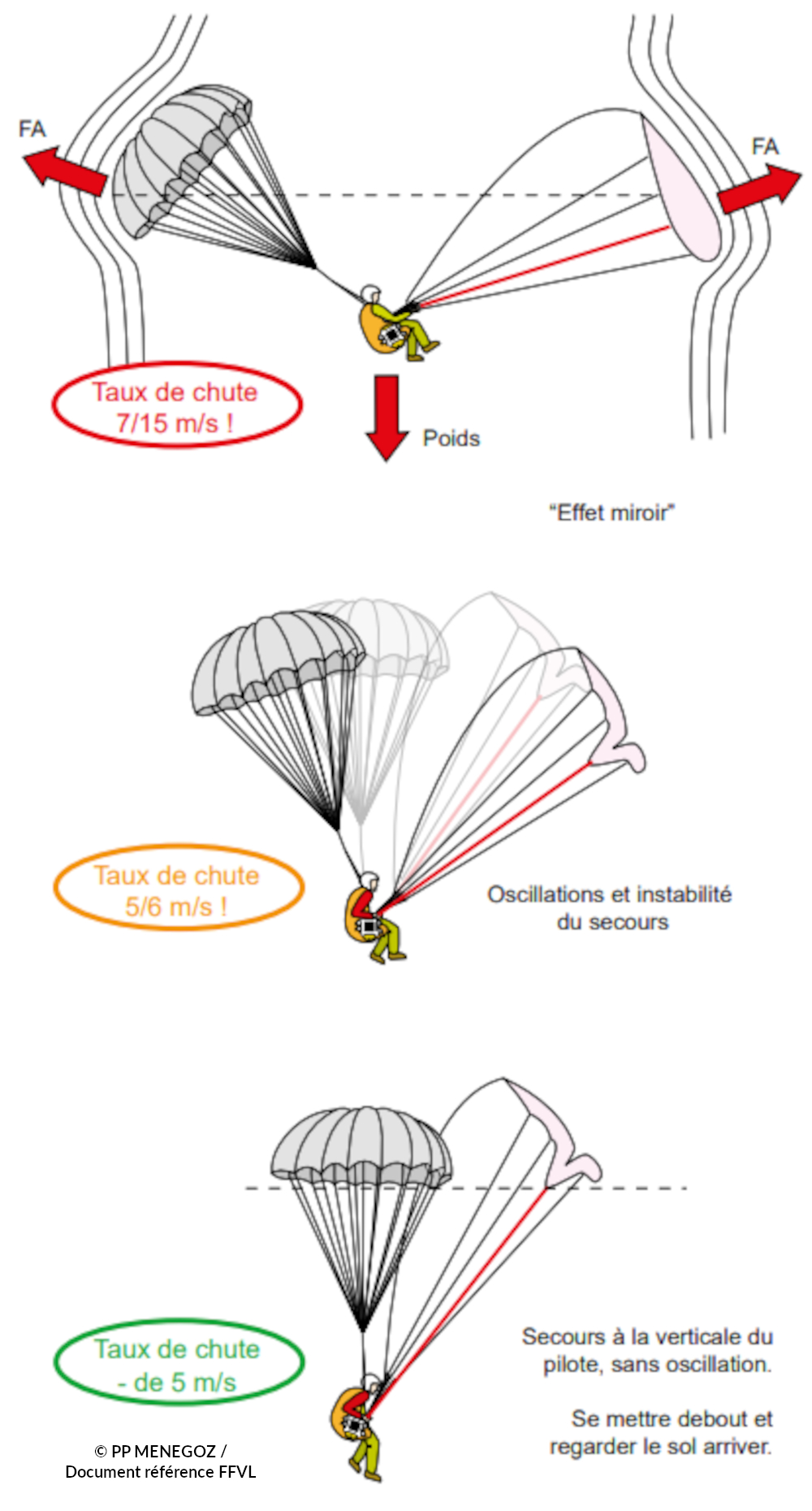
The sink rate corresponds to the vertical descent speed, expressed in m/s. The higher this speed, the rougher the landing will be. The homologation limit (5.5m/s) still causes the pilot to hit the ground at nearly 20km/h! Which is far from the smooth landing we know under our paragliders!
It is essential to reach the ground as gently as possible, because we do not always know what type of terrain we will find when landing: 5.5m/s in a field where we can do a roll or in a corridor filled with rocks in the mountains, it is not the same thing. It is therefore one of the essential parameters to take into account when looking for equipment, the ideal being to find the model that offers the lowest sink rate.
But be careful: the value indicated by the manufacturer corresponds to a given size and PTV! It is essential to respect these values, to maintain an acceptable sink rate.
The theoretical sink rate can generally be degraded by:
– Non-compliance with the recommended PTV (Wing loading)
– Level of instability of the parachute
– Mirror effect, caused by a re-flight of all or part of the paraglider (see diagram).
Stability
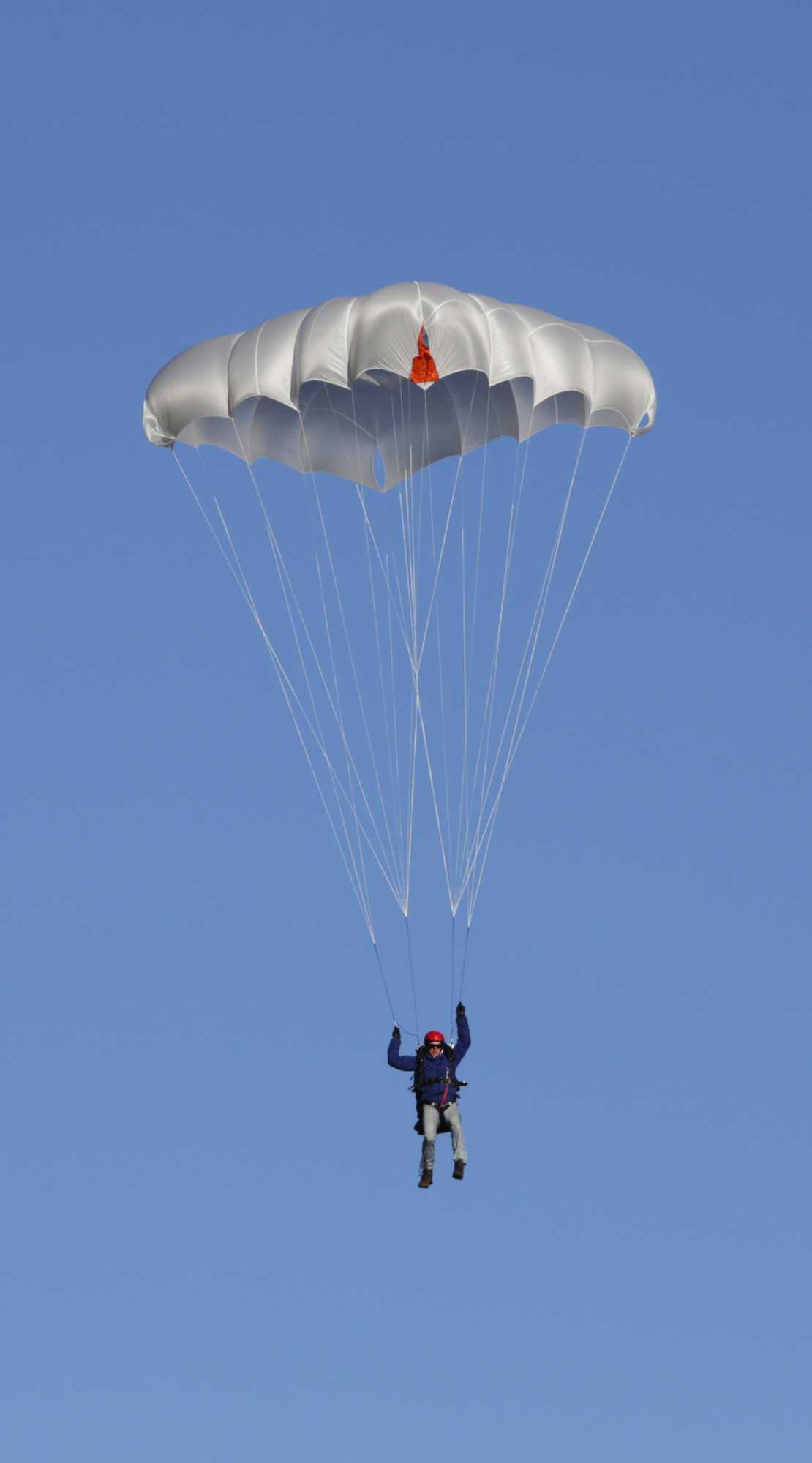
Landing gently on the ground under your parachute is good. But landing in a stable manner is better!
The stability of a rescue parachute is defined according to the pendulum amplitude of the oscillations that the pilot will have to undergo when suspended below, once the canopy is stalled and no longer creating disturbances. The smaller the amplitude of the oscillations, the more stable the parachute will be said to be. And vice versa…
This parameter is very difficult to quantify, and many external elements can degrade this behaviour in a real situation (sail that reinflates, parachute "tangled" with the sail, etc.). We consider here a standard and correct deployment of the parachute.
In general, square emergency parachutes (or similar shapes) are much more stable than hemispherical shapes. They stabilise much faster than hemispherical ones (1 or 2 oscillations max).
Their construction also makes them much less sensitive to aerological disturbances (turbulence), and allows them to maintain good stability throughout the descent.
Some models can even be used with a lower wing loading, while remaining just as stable (unlike hemispherical ones). The rate of fall can then be improved.
Steerability
Your emergency parachute is launched, you stall your wing by bringing it into a ball on your knees, you descend slowly without oscillations: ... PHEW, I'm saved!
But the valley breeze joins the party, and pushes you gently (but surely) towards a power line, a cliff, or any other unpredictable rejoicing ...
The vast majority of emergency parachutes available on the market do not have any system to manoeuvre and avoid a potential obstacle or try to get closer to a more suitable area to reach the ground: whether it is a clearing, or even the trees if necessary. Once under the rescue, it is no longer possible to act ...
Some models (few ...) have a system of handles that allow you to act on the wing to give a direction to the parachute. This is not a "brake" system like on your paraglider, but simply the possibility of deforming the wing to make it change course. You then have the possibility of avoiding the obstacle, aiming for a clear area, or simply facing the wind to slow down the arrival on the ground.
It is certainly unlikely that you will have to pull your rescue in your life as a pilot, but you can easily understand that having this possibility can be very interesting at the crucial moment.
The particular case of the "Rogallo":
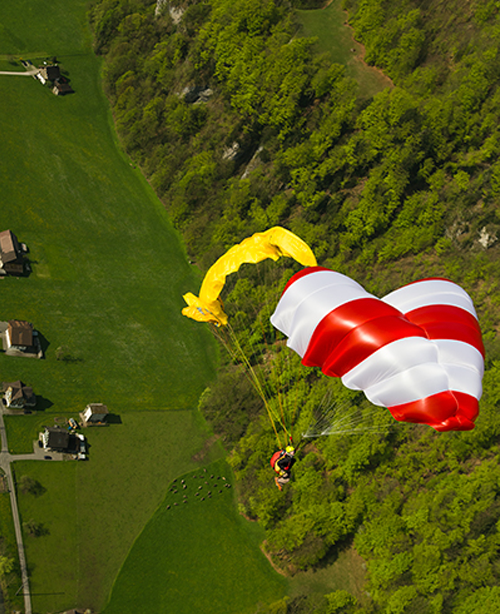
Known under different names (Beamer, Krisis, Control, ...), the Rogallo-type steerable parachute takes its name from Francis ROGALLO, an American aeronautical engineer at NASA who worked on biconical and flexible wings that retain their shape by air pressure. His work was the origin of the delta wings that appeared in the early 1970s and the "Parawing" wing used for some steerable emergency parachutes. This is a special case, because this type of emergency parachute, once opened, can be steered like a paraglider thanks to a braking line system acting on the wing. Very efficient (glide ratio < 3), but also more complex to manage, it requires some experience to be able to use it serenely. Its folding is also more complicated than its hemispherical or square counterparts. It must be meticulous and perfectly executed to guarantee the opening and proper functioning of it.
Other parameters
Your type of flying may also require comparing other parameters, such as weight, volume, folding method, etc.
Indeed, a World Cup competitor will not necessarily need an ultra-light reserve, unlike a Hike&Fly pilot. The aerobatic pilot who multiplies the opportunities to use their parachute (!) will favour a steerable to ensure landing and avoid injury, while the site pilot can let a professional take care of it, ideally twice a year.
Conclusion
The sink rate and stability are, in our opinion, the 2 essential and major parameters to consider when searching. The ability to steer comes in third but can represent a significant advantage over others. All other factors can refine your search, but should not take precedence over the first 2 for safety reasons.
WARNING:
Reducing the wing loading (by taking a larger size) will theoretically lead to a decrease in the sink rate, but may also degrade stability (especially on hemisphericals) and make the whole thing much more sensitive to turbulence. This decrease in stability may also lead to a less interesting sink rate, which is the exact opposite of the desired effect.
To shave a few hundred grams, it may also be tempting to choose a smaller parachute size (with the consequence of increasing the wing loading): we then add the 2 disadvantages: increased sink rate and increased oscillations (increased instability), resulting in a much more violent landing (too much?) for the human body!
If you are in doubt about your ability to bring the glider back into the flight envelope, the use of the parachute should obviously be preferred to the more random "it'll be alright!".
We recommend that you seek advice from professionals, and carefully analyse the characteristics of the different models on the market.
The choice of a parachute should not be taken lightly ...
– Favour a reserve that has passed the EN standard (rather than LTF), as the sink rate and stability tests are carried out as close as possible to reality, i.e. in the air with a real person underneath ... The shock-test is also carried out in the air, but with ballast.
– Be meticulous about folding, and strictly follow the manufacturer's recommendations (manual). The proper functioning of your reserve depends on it in case of need. Indeed, as the design is becoming lighter and lighter, manufacturers determine opening modes (through folding) that allow for more effective absorption of shocks related to opening.
– Opt for mounting the reserve risers at shoulder level when possible. This is the best position to reach the ground.
– Beware of front containers! They must have a retaining strap at the thighs, to prevent them from turning over when you grip the handle. In the worst case, you find the package on your knees, stuck behind the ventral and then there ...