Reflection on forgetting to attach in paragliding
Every year, several pilots lose their lives after forgetting to attach themselves correctly in their harness. These are generally not beginners …
During a safety evening organised by the CDVL74, a quick survey of the public revealed that 15% of them have already taken off with a total or partial omission of attachments.
CAUSES and CONSEQUENCES
The causes of these omissions can be numerous and very varied:
- Being disturbed during preparation
- Preparing in a hurry
- Not being at 100% fitness
- Having personal and/or professional worries
- Missing a take-off and partially detaching to climb back up more easily
- …
To see, the FFVL "safety" film: Attaching is vital!
https://www.youtube.com/watch?v=2bdZJeWiTos
The other FFVL safety films are available under: https://federation.ffvl.fr/pages/parapente-films-securite
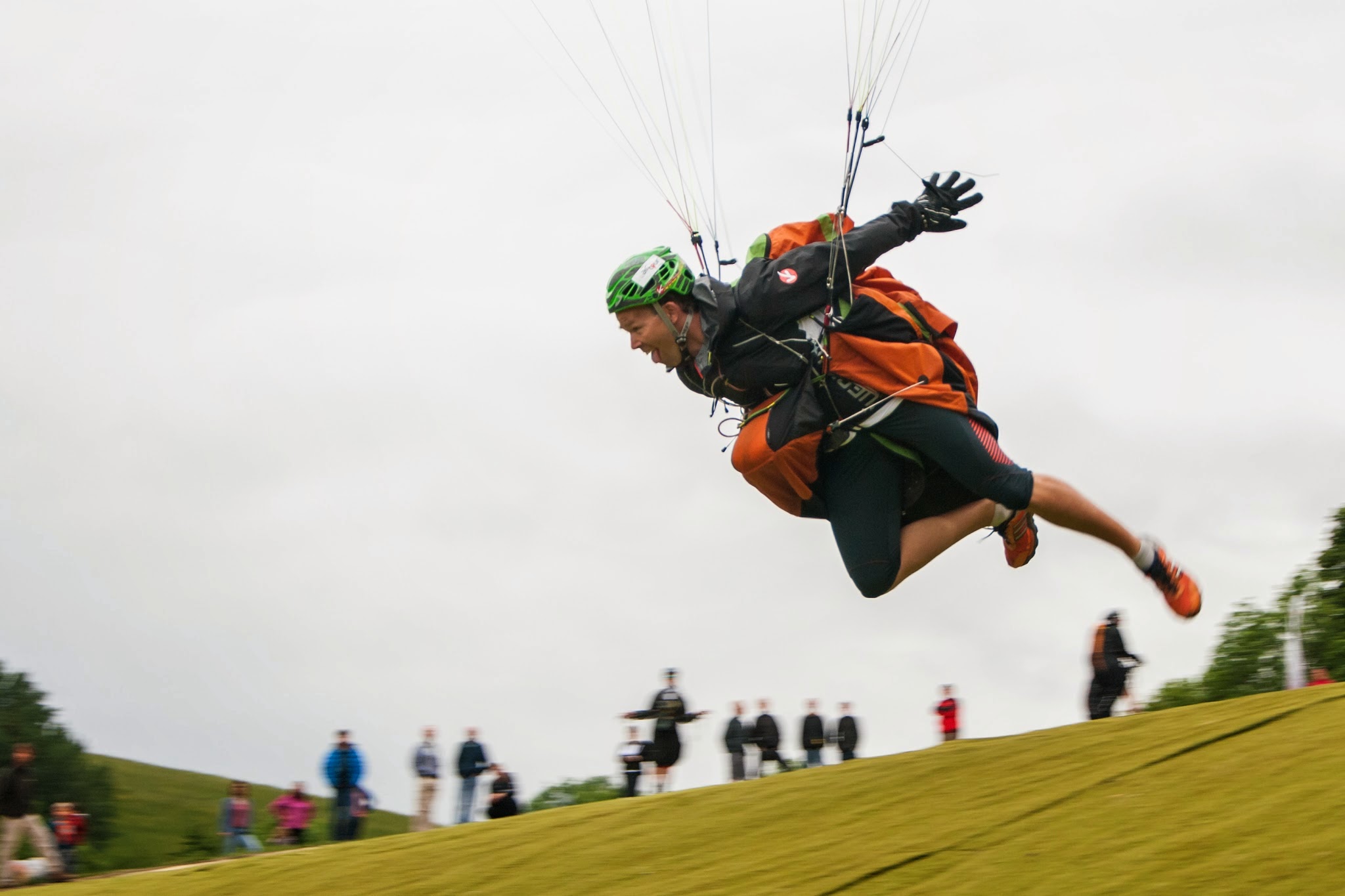
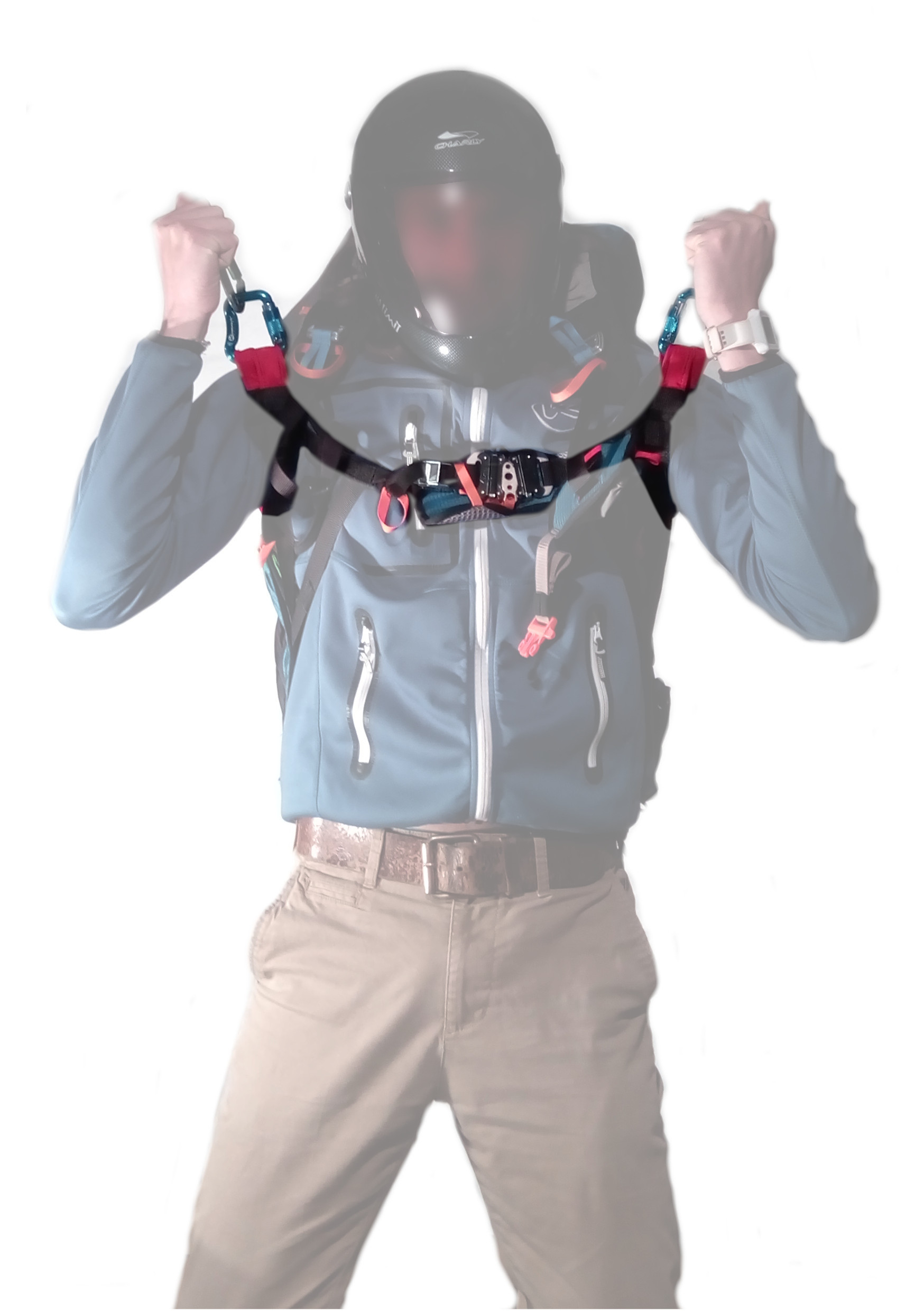
As a general rule, in the event of an oversight (for various reasons) and during the take-off phase, the harness "rises" in the back during the ascent of the wing and the ventral strap gets stuck under the pilot's arms, who then finds themselves in an unforeseen and surprising situation, and risks being carried away to a sufficient altitude to start being dangerous (several metres). Once stuck, and if the wing continues a trajectory moving away from the terrain, the reflex will be to want to lock the arms to maintain the blockage and try to land. Unfortunately, this position cannot be maintained for more than a few minutes because the straps compress the arteries located under the arms and therefore prevent the muscles from being supplied correctly with blood flow to maintain the blockage: the arms will therefore end up opening by themselves despite the best will in the world…
There are different techniques to implement if this ever happens to you:
- Climb back into the harness by gripping the risers with your feet. -> requires training, good physical condition, and very quick implementation so as not to be tired.
In video: https://www.youtube.com/watch?time_continue=20&v=j6BKfNpK19U
- Make a quick return to the slope or trees to limit the time spent in this position and attempt a tree landing. -> however, it may be difficult to manoeuvre the wing if you have released the brakes, which will probably be the case if you find yourself in this situation (see photo above)…
It's up to everyone to see…
It may also be that no strap is attached, and where the simple pressure of the shoulder straps can give the impression of having put on your harness completely! In this case, when the harness goes up, just let go of everything and raise your arms so that the harness can freely go up until it comes out without getting stuck, or do the same thing (arms up to get out so as not to get stuck) while keeping the brakes on so as to release the glider.
To see: A pilot gets out of his harness on take-off after realising that he was not attached.
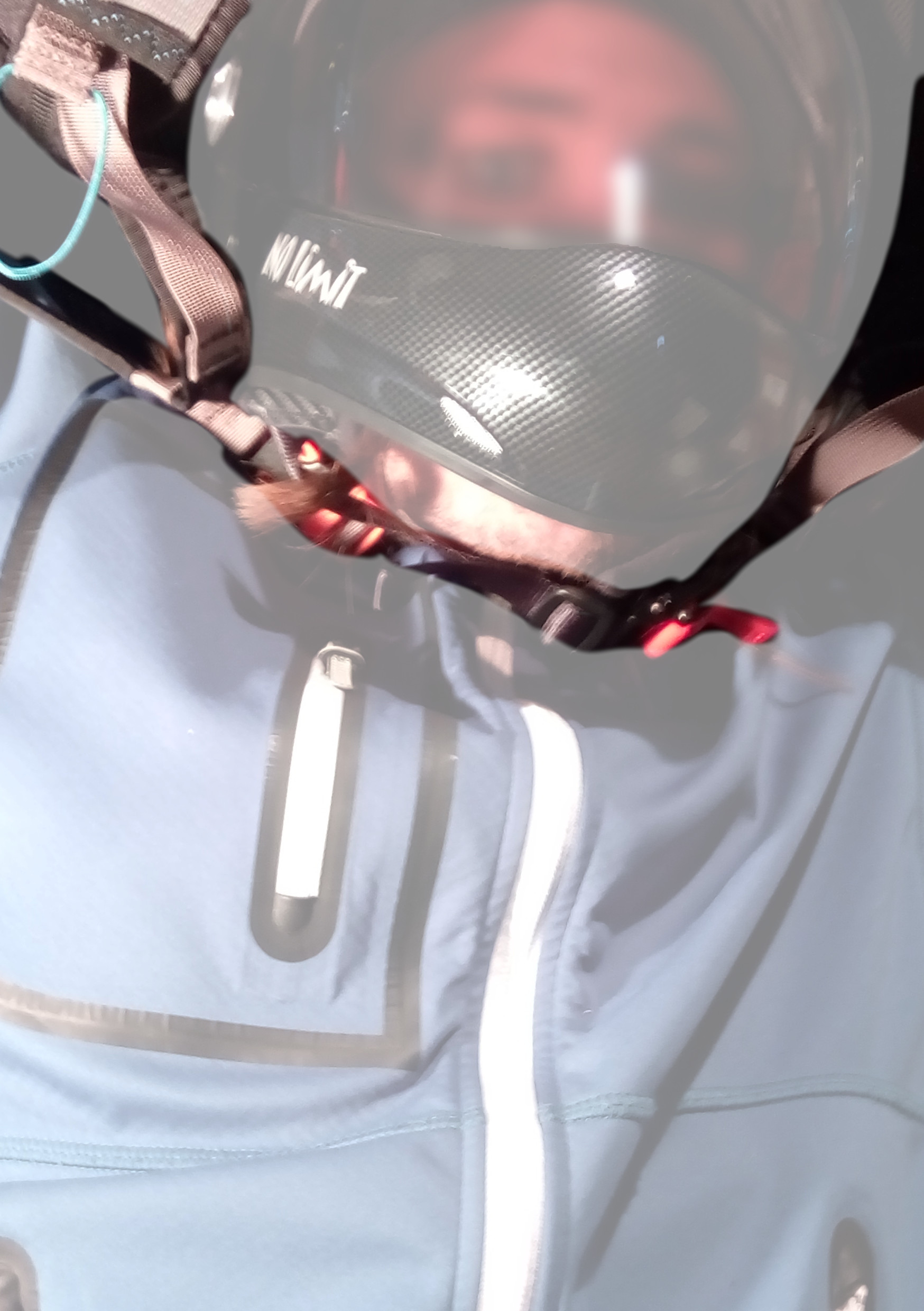
Also pay attention to the chest strap, which despite its apparent weak construction (small plastic clip) can prove to be strong enough to get stuck under the head or chin of a full-face helmet for example (in the event of forgetting to attach it), and generate sufficient blockage to prevent the harness from escaping from above as presented above.
Even if we see that all the causes identified so far are of human origin, manufacturers must integrate these aspects into their design in order to offer technical solutions that avoid the worst in the event that the pilot finds himself in one of the situations described above.
The solutions described below are intended to be general so that you can compare the existing solutions from different manufacturers. The remarks provided only concern the attachment aspect of the buckles and not the intrinsic qualities of this or that harness.
TECHNICAL SOLUTIONS: The geometry of the harnesses
Harness with separate thigh + ventral straps
This is probably the geometry that the majority of pilots know, and it is also the one that can generate the most problems!
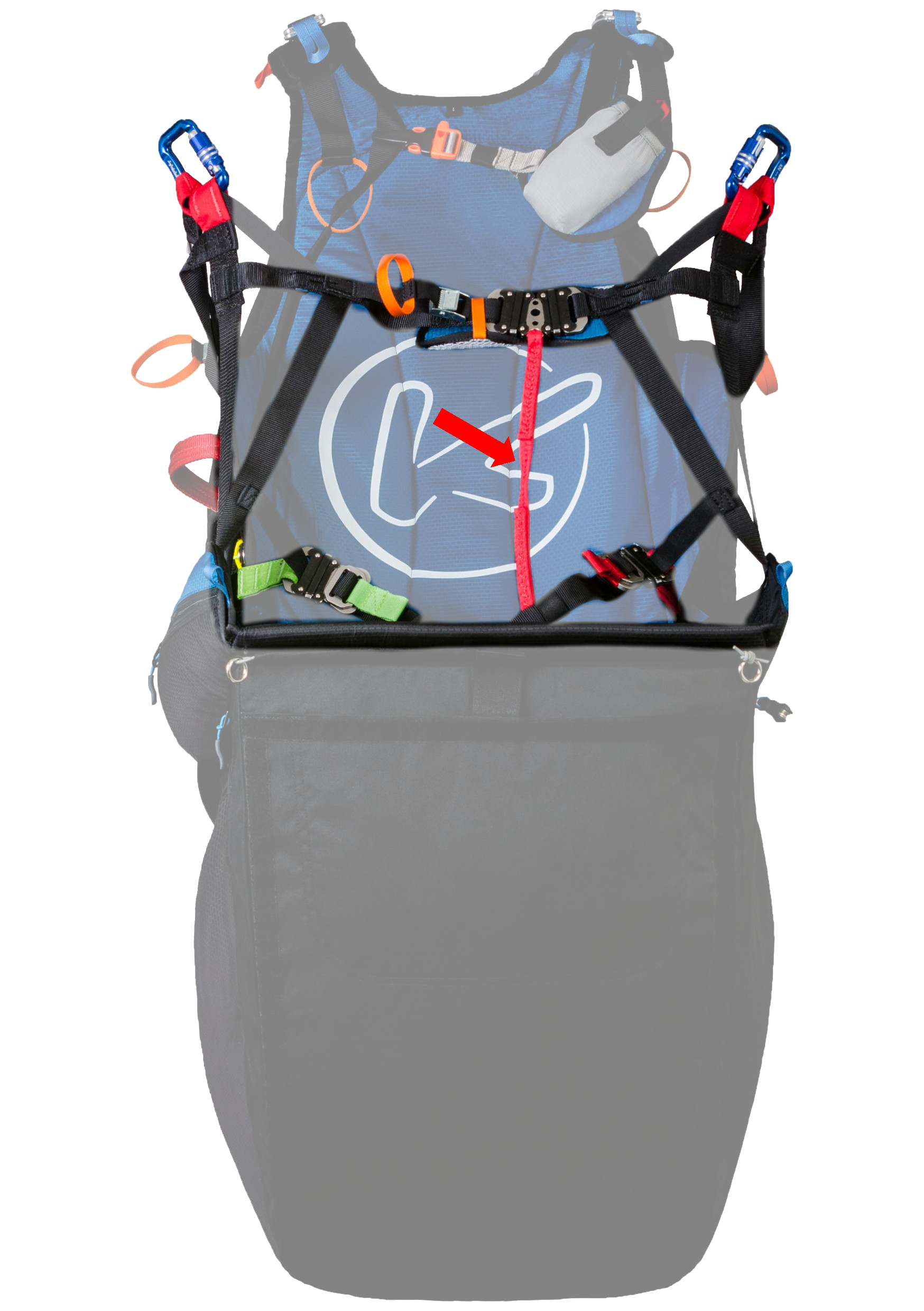
On this type of geometry, there are 3 distinct points to attach to completely close the harness: the ventral, and the 2 thighs. Contrary to what one might think, it is the thighs (and not the ventral) that are the most important on take-off because it is they that prevent the harness from going up in the back and letting the ventral get stuck under the arms.
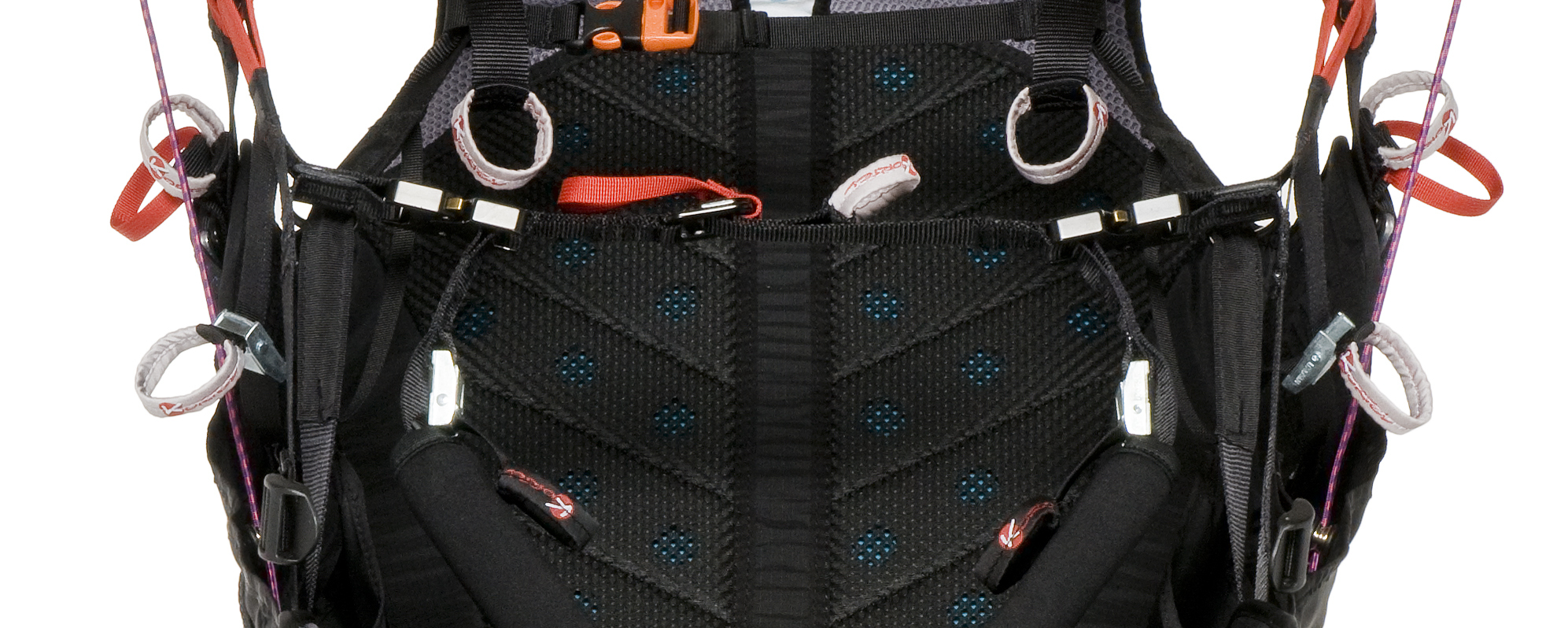
To date, the vast majority of harnesses with this geometry are equipped with an "anti-forget" strap (in red in the photo) which is attached to the strap of one of the thighs and has a part of the buckle that will lock the ventral strap. Thus, even if the thighs are not closed at take-off, or if they are reopened later (such as after a failed take-off to facilitate walking back up), this strap will prevent the harness from rising too high in the back. It will then potentially be possible to sit back correctly in the harness with the help of your hands, and close the buckles that remained open. However, pay attention to the length of this anti-forget device, because the longer it is, the lower the pilot will be and may no longer be able to use the brakes without risking stalling the wing!
Harness with "V" anchoring
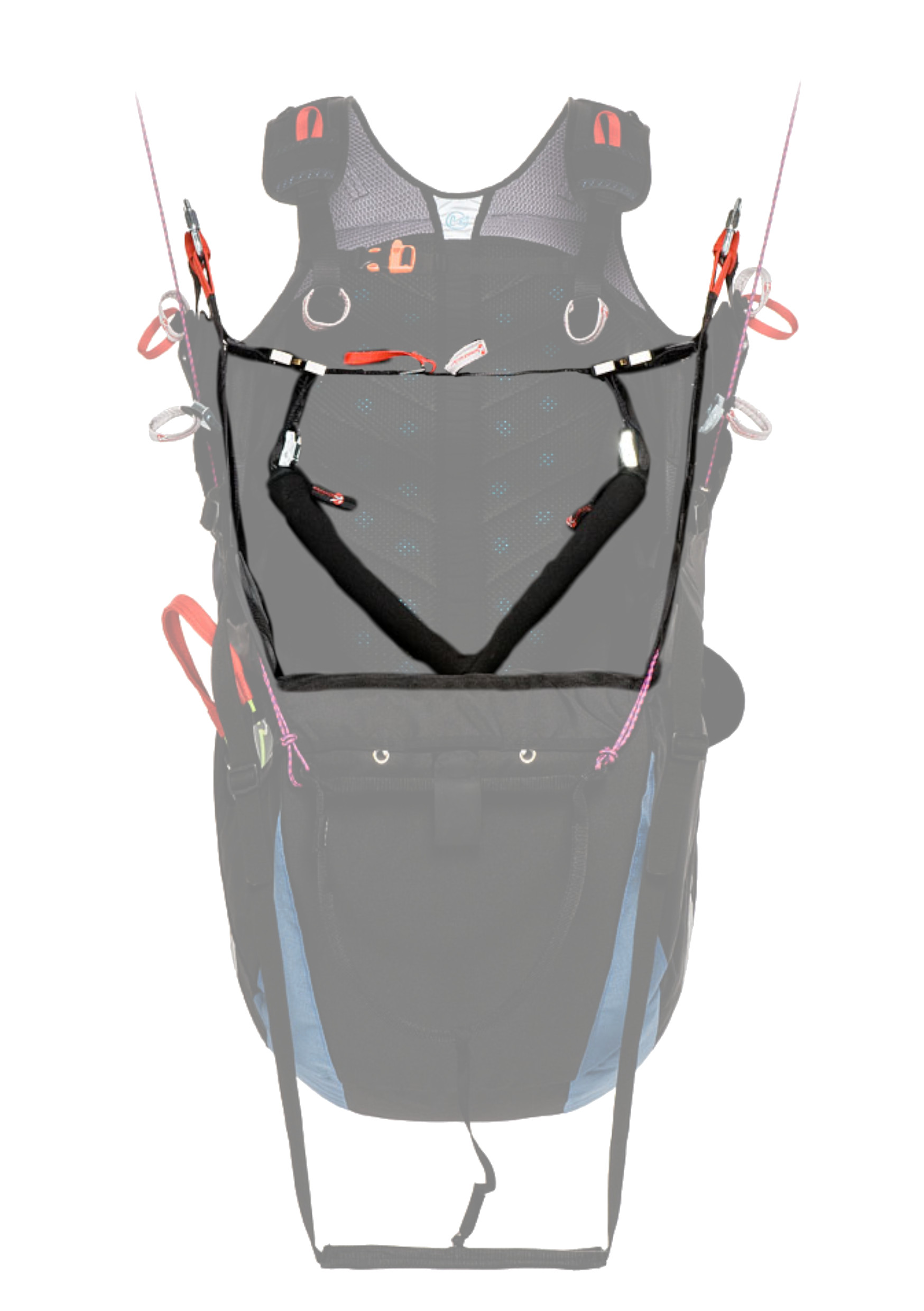
This technical solution, used in many current harness models, overcomes the forgetting to attach due to its own design. Indeed, as soon as one of the straps is attached, it becomes impossible to fall out of the harness.
In fact, we can consider that the 2 thigh straps are attached to the ventral one, and therefore that the anti-forget device presented above is integrated.
The position will not be comfortable (that's for sure!), but will avoid any accidental falls.
CAUTION: Depending on the seat of the harness (seat plate, separate leg pads, hammock), the pilot's position may generate an asymmetry at the harness level, which will certainly cause the wing to rotate.
Slip-on harness (without buckles)
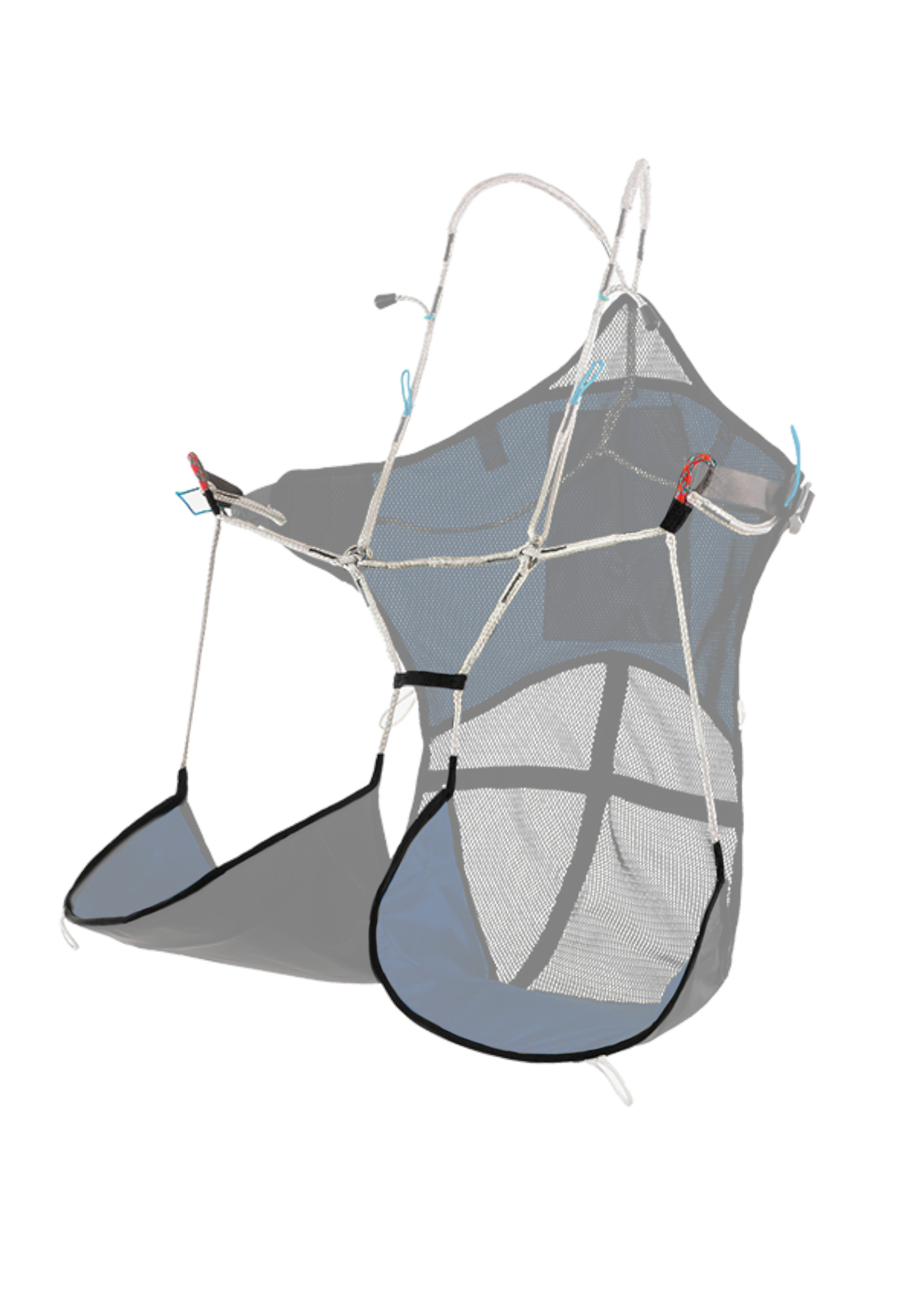
This technical solution is found on many mountain or hike&fly harnesses, where the buckles have simply been removed to save weight, but not only.
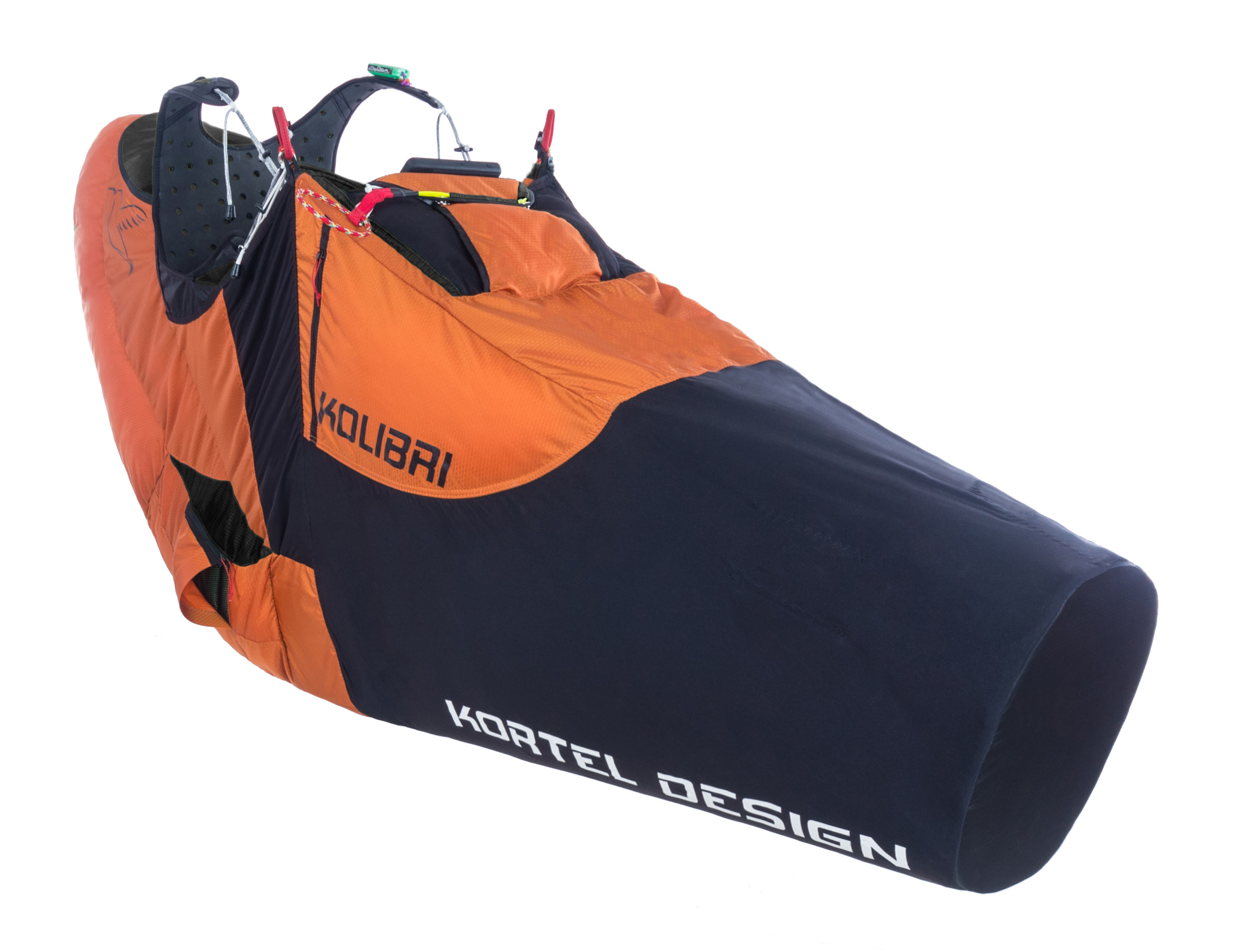
For the Kolibri for example, it was deliberately designed without closing buckles to limit as much as possible any risk of forgetting to attach for the original target audience, namely hike&fly or bivouac flight competition pilots. Indeed, the effects of accumulated fatigue during more or less long walks, and the rush that can be generated in the preparation phases for take-off (competition, changing conditions, strengthening wind, etc.) can be the cause of many cases of forgetting to attach. Pilots such as Antoine GIRARD have confirmed this to us with certainty.
These harnesses may therefore be less easy to put on, but it is also an additional guarantee of safety in view of the uses for which they were designed.
Therefore, there are various technical solutions provided by manufacturers on the harness models currently available on the market, and it is up to you to find out as much as possible when making a purchase.
ANOTHER POSSIBLE CAUSE: Omission by Obscuration
As we saw above, one of the major causes is pure and simple omission (for various reasons).
Another major risk is undoubtedly omission by "obscuration". Some accessories that are added to harnesses can partially or completely obscure the area where the leg straps and buckles are located. And when you lose sight of this area, the risk of forgetting to attach the leg buckles is increased.
This is particularly the case with cocoons fitted to harnesses, ventral rescue parachutes, cockpits, etc.
Here too, there are certain solutions offered by manufacturers to overcome these possible omissions.
ANTI-OMISSION ACCESSORIES
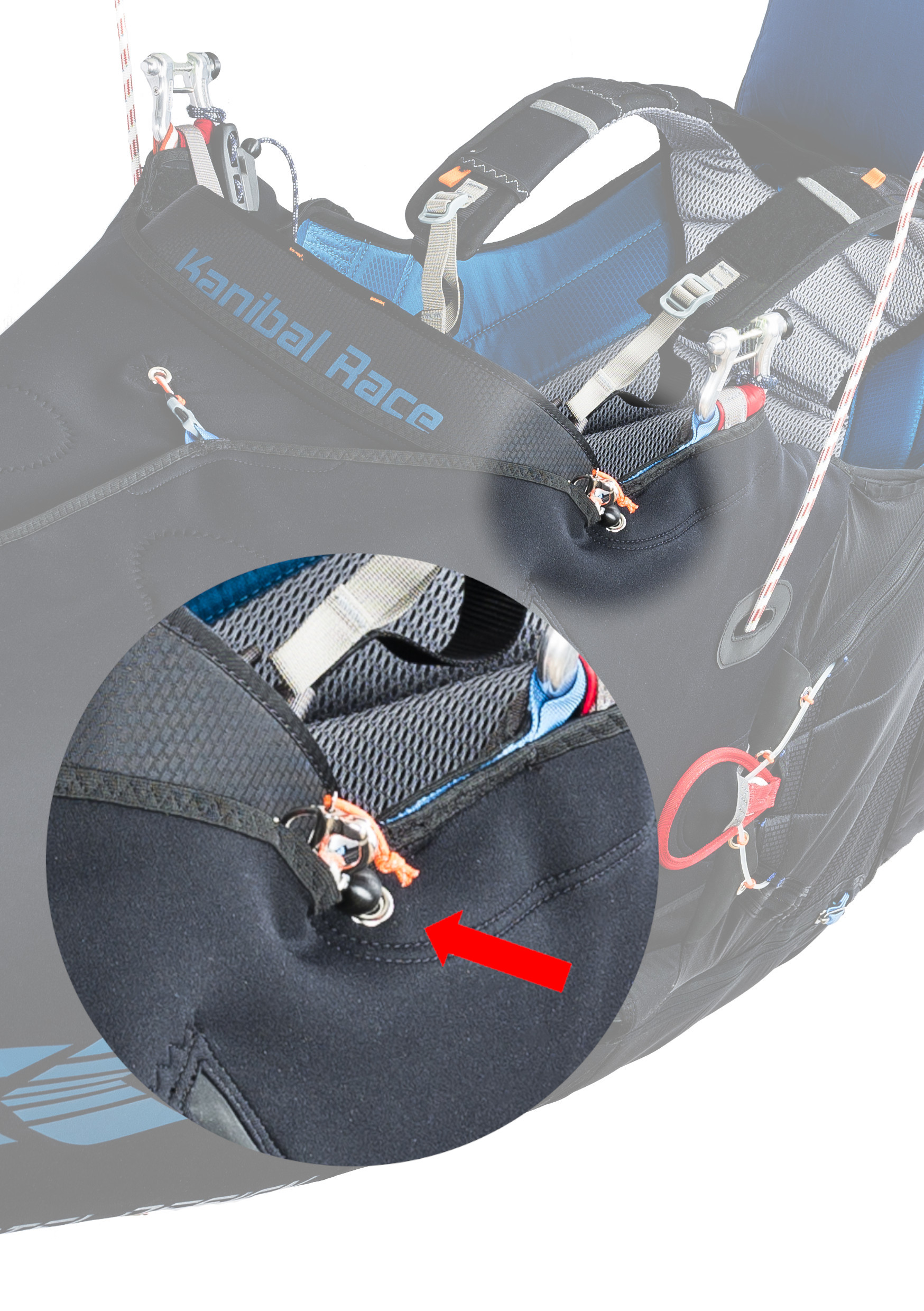
Cocoons
Cocoons cannot be directly considered as accessories, as they are often an integral part of the harness. However, their use can easily lead to attachment omissions.
In general (!) pilots take care of their equipment, and make efforts not to drag their harness on the ground, not to get it dirty, ... As a result, the first thing you may want to do on take-off is to close the cocoon to prevent it from dragging on the ground, thus masking visibility on the legs.
Some manufacturers therefore equip the closure of their cocoons with an anti-omission system connected to one of the leg straps. Thus, when you perform the action of closing the cocoon, you close one of the thighs at the same time to prevent the harness from rising up (as in the video: https://www.youtube.com/watch?v=M-lT6Rw9m8k ) if no other buckle is closed.
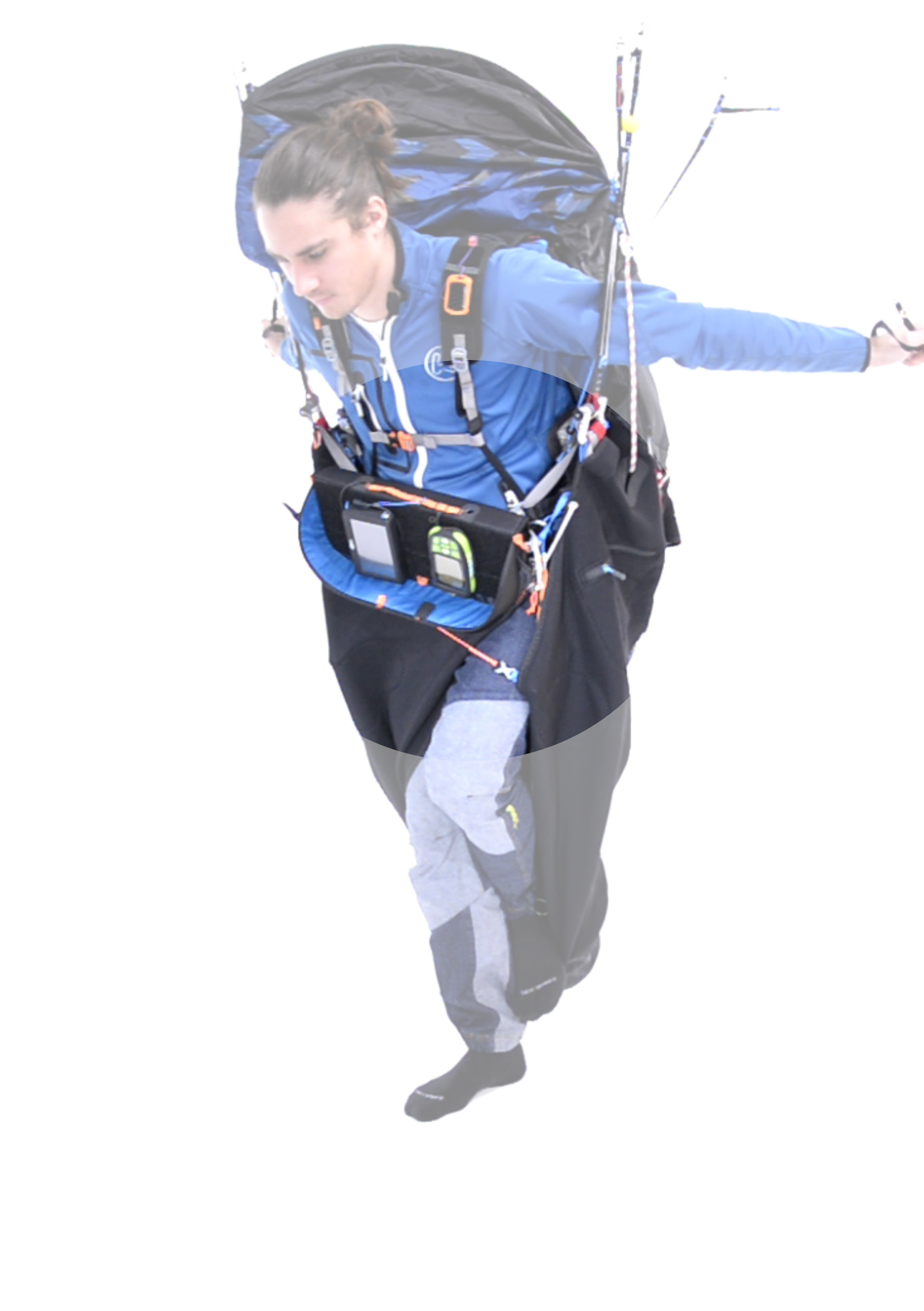
Cockpits
Similarly, cockpits are generally attached quickly, to avoid dragging them on the ground, risking damage to the instruments placed on them. As with the cocoon, they can then create a screen for visual verification of the closure of the buckles.
Some manufacturers, having taken this potential risk into account, have equipped their cockpits with an anti-omission system that connects one of the thighs to the connection of the cockpit itself. The installation of the cockpit therefore automatically leads to the closure of one of the thighs (as with cocoons, see above).
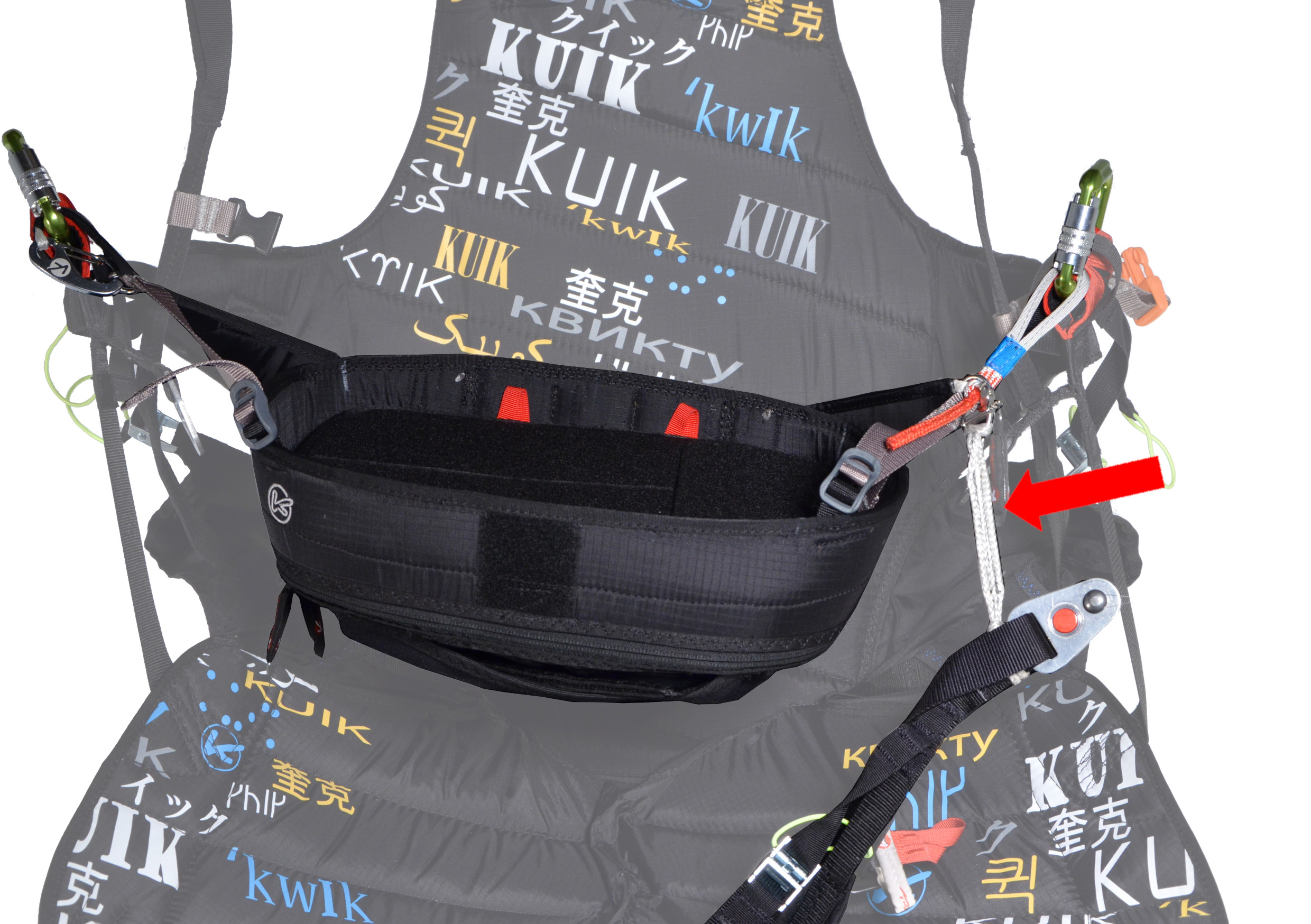
"Home-made" anti-forget
If your harness is not equipped with one of these anti-forget systems, or if you are afraid of finding yourself one day in one of the cases mentioned above, there is a simple solution to implement on any harness:
All you have to do is lock one of the thigh loops in the closed position.
To do this, you can use adhesive tape, elastic, a neoprene sleeve, or any other system that will prevent you from inadvertently opening this loop. For installation in the harness, you will have to pass your leg through the closed thigh, and you will immediately find yourself in a situation that will prevent you from falling out of the harness if you forget to close the other loops.
CONCLUSION
As we mentioned above, the causes of forgetting are of human origin, and can have different origins. Manufacturers are trying to provide technical solutions to assist the pilot and allow him to avoid certain dramatic situations, but these solutions cannot be considered "perfect" because they systematically require an action from the pilot who will have to do things correctly to guarantee his own safety.
Feel free to spread and share this reflection with as many people as possible, to make as many pilots as possible aware of this risk and avoid accidents that are already too numerous.
We are lucky enough to practice one of the most wonderful outdoor activities: flying
So take care of yourself, and happy flights!