Reflections on harness aerodynamics
The pursuit of increased paragliding performance involves, in part, reducing drag:
Improving profile efficiency by enhancing the lift-to-drag ratio
Reducing wingtip vortices
Decreasing the length of lines (4 -> 3 -> 2 lines)
Reducing pilot drag by transitioning from seated to reclined positions, using cocoon harnesses, and streamlining harnesses.
But what is the influence of these different parameters?
At a flight regime with maximum glide ratio, drag is roughly divided as follows:
50% induced drag (related to the profile's lift)
50% friction drag, roughly equally distributed between the friction drag of the wing fabric, the lines, and the pilot (the surface area of 250m of line with an average diameter of 0.8mm is equal to 0.2m2, which is approximately equivalent to a modern competition harness as measured in a wind tunnel).
At higher speeds, induced drag will decrease (as lift decreases), while other types of drag will increase with the square of the speed, but their exact proportions are not known.
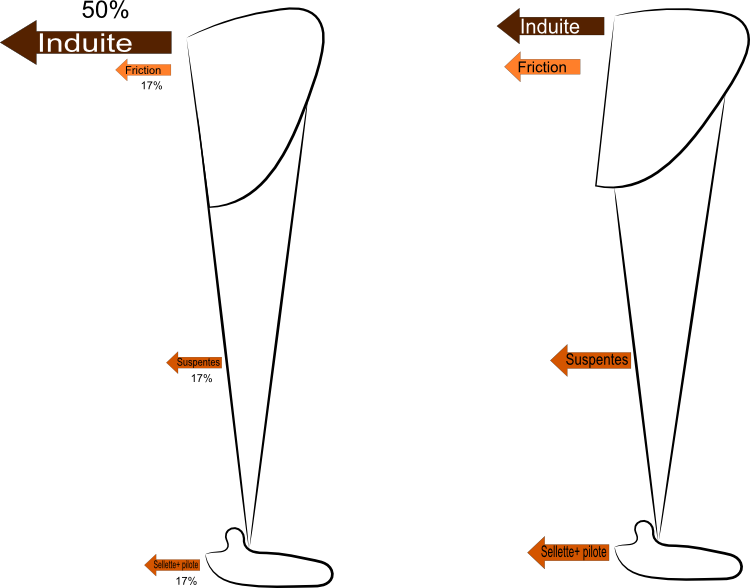
Thus, pilot drag represents approximately 20-25% of the total drag of a paraglider.
Assuming it is still possible to reduce this drag by 50% (i.e., a drag equivalent to a surface area of 0.1m2), one could theoretically gain 1 point of glide ratio on a wing with a glide ratio of 10.
But in reality, the transition from a seated to a reclined position (in theory, a change from an estimated surface area of 0.35m2 to 0.2m2), representing a theoretical drag reduction of 40%, has not resulted in the equivalent theoretical gain in glide ratio.
Similarly, the appearance of certain streamlined models at the rear has not had a clear impact on performance gains, even though base drag is clearly a penalizing factor in aerodynamics.
We therefore wanted to know more, but lacking the resources to launch a large-scale wind tunnel testing campaign, we opted for numerical simulation, without any illusions about the actual value of the results obtained, but rather betting on their comparative qualities.
Several profiling shapes were designed. The aim of the results was to study both the drag generated by these shapes, at a global level, and to decompose it into lift/induced drag.
But another avenue quickly emerged: the polar curves of these shapes. Indeed, it is useless to have the most aerodynamic shape possible if you are not able to maintain it in its optimum position. However, in paragliding, the angle of incidence varies by more than 5° depending on the flight regime, and there is nothing to precisely and accurately control our attitude in the air.
Comparisons between photos of threads placed on a current Kanibal Race and the flows obtained in simulation show that the latter are clearly too clean, but not completely far-fetched.
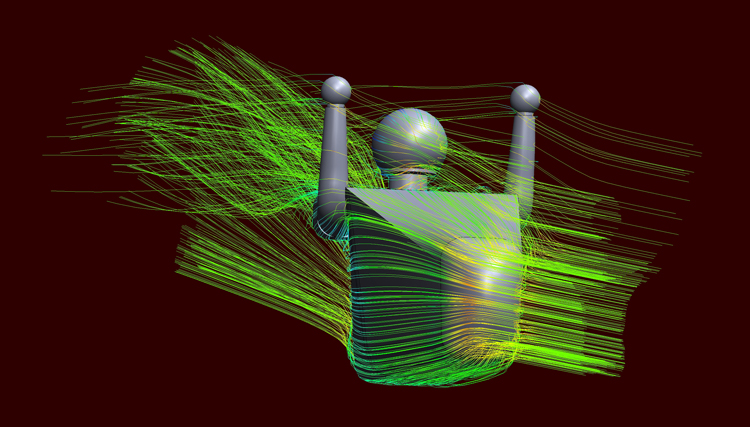
The different modeled shapes are as follows:
Current Kanibal Race.
Pointed profiling as can be seen at the moment.
Bow profiling to avoid having a lifting profile downwards.
Profiling of the head and shoulders, with different shapes
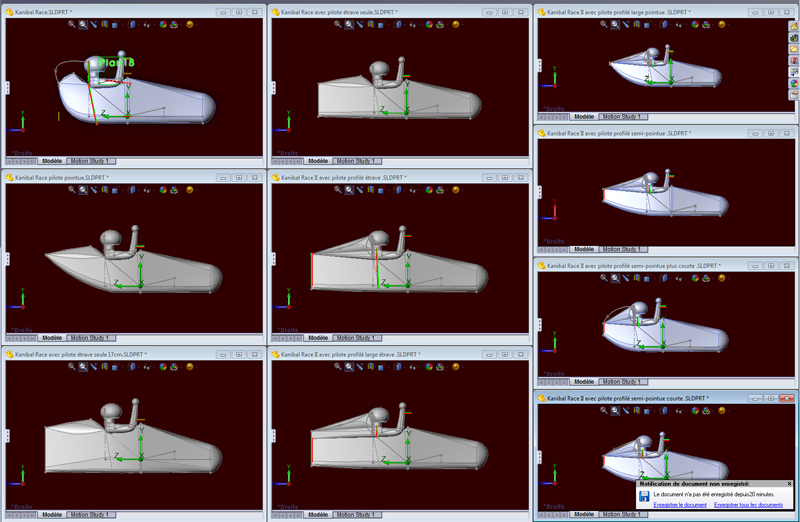
Without giving you the details of the results, compared to a current Kanibal Race, it appears that the current pointed profiles do not bring anything, partly because they do not address the problem, but also because the scoops necessary to shape them compensate for their small gain.
Surprisingly, it seems that on these current geometries, it is much more interesting to have the air flow coming from below (by about ten degrees, i.e. a very flat attitude), and not to have the cocoon well aligned in the air flows.
Indeed, the clearly penalizing area being the upper body, the neck, the head and the arms, by having a flow that arrives from below, the body of the cocoon "masks" this penalizing area and improves the flow. Having the feet pointing slightly downwards is clearly catastrophic.
So stop making fun of your buddies who have their feet in the sky, they're right!!
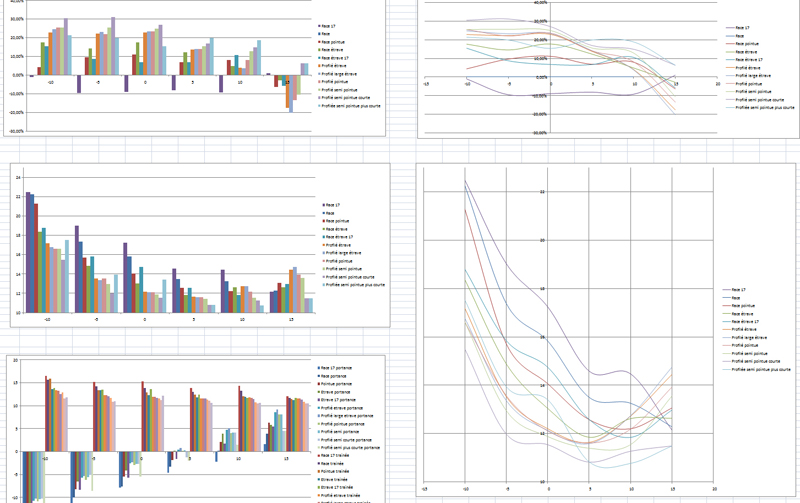
It is also clear that proper profiling of the shoulders, head and neck helps a lot.
Bow profiles are good, but very little tolerant to the angle of attack of the air streams.
There is not much to be gained by inconsiderately lengthening the length of the profiling. Is what we gain perhaps partly lost by the increase in wetted surface?
Some geometries are more tolerant than others to the orientation of the air flow.
In the end, the maximum potential gains are of the order of 20% with the optimal attitude, on the 20% of drag allocated to the harness. That is 4-5%, so surely even less in reality. We are therefore talking about an improvement in glide ratio of the order of a few tenths of a point. Which remains a significant stake in competition.